

WTV
If you’ve spotted “WTV” in a text message, a TikTok comment, an Instagram DM, or a group chat, you’ve probably wondered what it means. The short answer: WTV is an internet shorthand for “whatever.” It’s used to signal indifference, flexibility, mild annoyance, or a wish to move on from a topic.
The definition itself is simple, but the tone attached to it is anything but the same three letters can read as relaxed and friendly between close friends, or cold and dismissive in the middle of an argument. This guide walks through what WTV means, where it came from, how its tone shifts with context, when to use it, when to avoid it, and how it compares to similar internet abbreviations.
What Does WTV Mean in Slang?
WTV is a shortened form of “whatever.” People typically reach for it when they don’t have a strong preference, don’t mind which option gets picked, want to close out a topic, feel a bit irritated, or simply want to sound casual and unbothered.
Take this exchange: “Where should we eat tonight?” “WTV, you choose.” Here, WTV essentially means “whatever you want” and reads as neutral, even agreeable. But swap the context to a disagreement, and the same word can sound curt or checked-out. The core meaning of WTV doesn’t change; it’s the surrounding conversation that decides whether it lands as easygoing or dismissive.
Why Is WTV So Popular?
WTV caught on for the same reason most texting abbreviations do: it’s fast. Typing three letters is quicker than typing eight, and digital conversation texts, DMs, comments, gaming chats rewards brevity.
It also fits naturally alongside other shorthand people already use daily, like LOL, IDK, IDC, BTW, and NVM. Beyond speed, WTV packs in an attitude without requiring a full sentence to explain it, which is exactly what casual messaging calls for.
Where Did WTV Come From?
WTV is part of a much larger pattern: the compression of everyday English into fast-typing shorthand that took off with SMS and early instant messaging. “Whatever” was already a common, slightly moody word in spoken English long before texting existed, so it was an obvious candidate for abbreviation once people started typing on flip phones and early chat clients.
An Urban Dictionary entry defining “wtv” as “whatever” dates back to December 2004, which means the abbreviation has been documented online for more than two decades. Since then, it has spread across text messages, forums, social media platforms, and gaming chats, with the lowercase “wtv” now the more common form in casual writing.
The Emotional Meaning Behind WTV
WTV is rarely emotionally neutral its meaning shifts with the situation it’s dropped into:
| Context | Likely Meaning |
| Choosing food | Anything is fine |
| Making plans | I don’t mind |
| Minor disagreement | Whatever, it’s okay |
| An argument | I don’t want to discuss this |
| Frustration | I’m done caring |
| Casual joking | Whatever 😂 |
Punctuation and emojis push the tone further in one direction or the other. “wtv 😂” reads as playful. “wtv.” with a hard stop can feel cold or final. “WTV!!!” in all caps with exclamation points usually signals frustration. Because text strips out tone of voice and facial expression, the words around WTV and the relationship between the people texting end up doing most of the interpretive work.
How to Use WTV in a Sentence
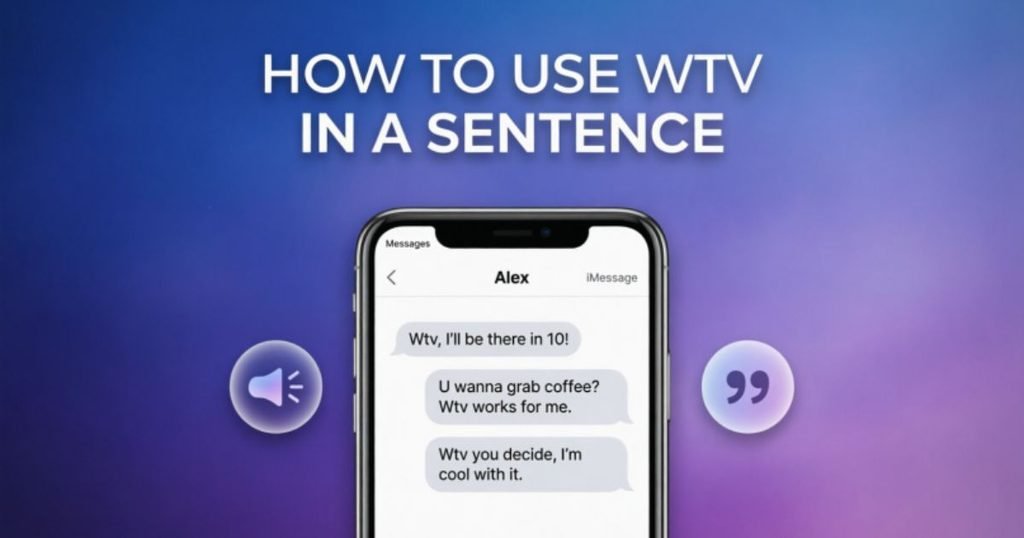
A few real-world examples show how flexible the abbreviation is:
- Making plans: “What time should we meet?” / “Wtv works for me.” meaning any time is fine.
- Choosing food: “Pizza or burgers?” / “WTV, I’m hungry.” meaning either option works.
- Ending a minor argument: “You always choose the movie.” / “WTV, pick one.” meaning a wish to stop arguing about it.
- Casual chat: “Are you going to the party?” / “Maybe, what happens.” meaning a relaxed, not-too-serious attitude.
- Dismissal: “You should really listen to me.” / “WTV.” this one can easily come across as irritated or dismissive.
The safest move before hitting send is to consider whether the person on the other end will actually pick up on the tone you intend.
WTV vs. “Whatever”: Is There a Difference?
The underlying meaning is identical, but the style differs:
| WTV | Whatever |
| Very informal | Informal to neutral |
| Common in texting | Common in speech and writing |
| Faster to type | More complete |
| Mostly used online | Used everywhere |
“WTV, you decide” and “Whatever, you decide” say the same thing, but the abbreviated version reads more like pure internet shorthand, while the spelled-out word can comfortably appear in spoken conversation too.
Related Slang and Variations
WTV belongs to a whole family of casual abbreviations that show up in similar conversations: IDC (“I don’t care”), IDK (“I don’t know”), NVM (“never mind”), W/E (another way of writing “whatever”), TBH (“to be honest”), IMO (“in my opinion”), and FYI (“for your information”).
You may also come across WTVR as a variant, though spelling and exact meaning can shift slightly between communities. As with most slang, it’s worth reading the full message rather than interpreting any single abbreviation in isolation.
When Not to Use WTV
WTV works fine in casual, low-stakes messaging, but it’s a poor fit in several situations: talking to a manager or employer, writing a professional email, discussing a genuinely serious problem, responding to someone sharing something emotionally important, messaging someone who might not recognize the slang, or any moment where you need to come across as respectful and composed. Replying “WTV” to a teacher, client, or customer can easily be read as careless or disrespectful, even when that isn’t the intent.
Better Alternatives, Depending on the Situation
| Situation | Better Alternative |
| Casual choice | “Either is fine.” |
| Professional choice | “I don’t have a preference.” |
| Friendly conversation | “Whatever works for you.” |
| Serious discussion | “I’m open to your suggestions.” |
| Ending a disagreement | “Let’s leave it there.” |
| Showing acceptance | “That’s fine with me.” |
Swapping in one of these phrases lowers the odds that your message comes across as dismissive, especially with people who don’t already know your texting style.
WTV on Urban Dictionary
Urban Dictionary’s top entries for “wtv” define it as shorthand for “whatever,” though as with most crowdsourced slang dictionaries there are also user-submitted alternate meanings tied to specific communities or inside jokes. For everyday texting and social media, “whatever” is still the meaning worth assuming first.
Is WTV Rude?
Not inherently, but it can certainly sound that way. “Wtv, do whatever you want” comes across as annoying almost no matter the context. On the other hand, “Pizza or tacos?” followed by “Wtv 😂 I’m good with either” reads as easygoing and friendly.
What tips the balance is a mix of the relationship between the people texting, the seriousness of the topic, punctuation, emoji use, and whatever was said right before it.
How WTV Shows Up Across Platforms
The abbreviation travels well because it’s short enough to fit anywhere. In text messages, it’s a quick way to reply between friends or family. On Instagram, it shows up in DMs, comments, and captions. On Snapchat, it fits the platform’s fast, casual messaging style. On TikTok, it appears in comments and direct messages.
In gaming chats, players use it when they genuinely don’t care which map, character, or mode gets picked. And in group chats, a one-word “WTV” reply can mean genuine flexibility about plans or it can be a subtle sign that someone is losing interest in the conversation.
The Psychology Behind Saying “Whatever” or “WTV”
There’s no single psychological explanation for why someone types WTV; it depends heavily on the moment. It can reflect real indifference, flexibility, mild frustration, emotional distance, conflict avoidance, or simply a desire to wrap up a discussion.
Also Read This: What Does “Ate” Mean in Slang
Someone who texts “WTV, you choose” when picking a restaurant likely has no real preference. Someone who replies with a bare “WTV” after a serious disagreement is probably signaling they don’t want to keep talking about it. The word itself doesn’t tell you which one you’re dealing with and the behavior and context around it do.
WTV in Relationships and Friendships
Between close friends who already understand each other’s texting habits, WTV is usually harmless. “Movie tonight?” “Wtv, you pick 😂” isn’t likely to cause any confusion. But during an actual relationship conflict, the same word can create real misunderstanding.
If one partner says “I feel like you don’t listen to me” and gets back a flat “WTV,” it can land as dismissive or uncaring, even if that wasn’t the intent. When emotions are running high, spelling out what you actually mean tends to serve the conversation better than shorthand.
WTV in School and Teen Slang
WTV is widely understood as standard internet shorthand among teens and young adults, who use it constantly in group chats, DMs, gaming conversations, and social media comments. That said, everyday familiarity with the term doesn’t mean it belongs in schoolwork; formal writing, essays, and assignments still call for complete words and appropriately formal language.
Is WTV Appropriate at Work?
Generally, no. In professional settings, WTV tends to read as careless or dismissive rather than casual and friendly. Compare “WTV works” to “Either option works for me,” or “WTV, you decide” to “I’m happy with whichever option you prefer.”
The second phrasing in each pair sounds far more appropriate for emails, workplace messaging, customer service, or any communication where you want to be taken seriously.
Common Misunderstandings About WTV
A few myths are worth clearing up. First, WTV doesn’t always signal anger often, it just means the person has no strong preference. Second, it isn’t automatically rude; tone depends heavily on context.
Third, it doesn’t have one fixed meaning everywhere “whatever” is the dominant meaning in mainstream texting, but niche online communities sometimes use it differently. And finally, capitalizing it (“WTV” versus “wtv”) doesn’t make it more polite, but capitalization can add emphasis, but it doesn’t change the underlying tone on its own.
WTV Compared to Similar Abbreviations
| Slang | Full Meaning | Main Idea |
| WTV | Whatever | Indifference or flexibility |
| IDC | I don’t care | Stronger indifference |
| IDK | I don’t know | Uncertainty |
| NVM | Never mind | Dropping a topic |
| TBH | To be honest | Introducing an opinion |
| IMO | In my opinion | Giving an opinion |
| WYD | What are you doing? | Asking about someone’s activity |
Of these, IDC, NVM, and W/E sit closest to WTV in meaning, though none of them are perfectly interchangeable; each carries a slightly different shade of tone.
How to Respond to Someone Who Says “WTV”
If it’s unclear what someone means by “WTV,” a little clarification goes a long way. If they seem genuinely fine with either option, you can just move forward: “Okay, let’s go with pizza.”
If they seem annoyed, try checking in directly: “Are you upset, or are you okay with either option?” If they seem to be signaling they’re done with the topic, giving them space works better: “No worries, we can talk about it later.” And if you’re simply unsure, it’s fine to just ask: “When you say WTV, do you mean you don’t mind?”
WTV Across Cultures and Languages
WTV originates in English and remains closely tied to English-language internet culture, but slang spreads fast through TikTok, Instagram, YouTube, gaming platforms, and messaging apps, so it’s not unusual for non-native English speakers to encounter it online as well.
How “indifferent” or “dismissive” the word actually feels can vary between cultures, since attitudes toward expressing disagreement or apathy aren’t universal.
Why People Keep Using WTV
The appeal comes down to efficiency and flexibility. Three letters can stand in for a whole sentence like “I don’t really have a preference, so you can decide,” and the same three letters can flex to sound relaxed, funny, unbothered, indifferent, or annoyed depending on how they’re deployed.
That versatility is a big part of why WTV has stuck around in online conversation for more than twenty years.
The Bottom Line
The definition of WTV is simple: it means “whatever.” What actually matters is the tone riding along with it. A cheerful “wtv 😂” usually just means “I don’t mind,” while a flat “WTV.” dropped into an argument can feel like a door closing.
The safest approach is to save WTV for casual, low-stakes conversations where your tone is already understood, and to reach for clearer, fuller language in professional or emotionally serious moments. Once you factor in context, WTV is easy to read correctly and easy to use without sending the wrong message.

Welcome to Meaning Mints! I ‘m Olivia Justin , an Ai-powered SEO, and Content Writer with 4 years of experience.
I help website rank higher, grow traffic , and look amazing. My goal is to make SEO and web design simple and effective for everyone.
Let’s achieve more together |
