

If you’ve seen “BBC” pop up in a text, a caption, or a comment section and paused to wonder what it actually means, you’re not alone. In most everyday contexts, BBC stands for the British Broadcasting Corporation, the UK’s public broadcaster. But online, especially in casual chat and social media, BBC can also carry an explicit adult slang meaning tied to racialized sexual stereotypes.
Neither meaning is “the” correct one on its own. The word or letters around BBC, the platform it appears on, and who’s saying it all decide which meaning applies. This guide breaks down both meanings clearly, shows how to read BBC in different apps and situations, and gives you simple ways to figure out and respond to what someone actually means.
What Does BBC Mean?
BBC most commonly means British Broadcasting Corporation, the UK’s publicly funded national broadcaster, known for outlets like BBC News, BBC One, and BBC Radio. This is the formal, dictionary-recognized meaning and the one you’ll see in news articles, official documents, and everyday references to television or journalism.
BBC can also be internet slang with an explicit adult sexual meaning, referencing a racialized stereotype about Black men. This usage is common in adult content, memes, and certain corners of social media and messaging, but it’s a slang term, not a formal or dictionary-standard definition.
| British Broadcasting Corporation | Adult Slang Usage | |
| Type | Formal organizational initialism | Informal internet/adult slang |
| Common setting | News, TV, official writing | Adult content, memes, casual chat |
| Recognized by | Dictionaries, government, media | User-generated slang communities |
| Appropriate for school/work | Yes | No |
The safest approach is simple: check the context before assuming either meaning.
BBC Meaning in Text
In a text message, BBC is interpreted almost entirely by what’s around it. A message like “did you catch that BBC documentary last night?” is clearly about the broadcaster. A message with sexual or flirtatious framing points toward the slang usage instead.
Examples:
“BBC News just posted an update on the election.” (Clearly the broadcaster)
“lol he’s so extra, total BBC vibes 😂” (Ambiguous could be a joke, a media reference, or slang, depending on the relationship and prior conversation)
When BBC appears with no clear topic attached, the safest move is to look at the rest of the conversation, not just the three letters themselves.
What Does BBC Mean Gen Z?
BBC isn’t a term Gen Z invented or uses exclusively; it predates any single generation’s slang. What is generational is how abbreviations like BBC get used: layered with irony, memes, and deliberately ambiguous humor.
Gen Z chat culture often repurposes existing initialisms (media names, corporate acronyms, old slang) into jokes, reaction memes, or double entendres. That means BBC might show up in a joke about the news, a meme format, or, in adult-oriented corners of the internet, the sexual slang sense. The generation using a term doesn’t change its meaning the context still does.
BBC Meaning on Snapchat
On Snapchat, BBC usage splits along the same lines as everywhere else. In a Snap referencing a news story, a documentary, or a UK-related topic, it means the broadcaster. In private chats, especially between adults, it may be used in the slang sense Snapchat’s disappearing, private-messaging format makes it a common space for adult-oriented conversation.
Because Snapchat conversations are typically one-on-one and informal, tone matters more than usual. If the surrounding messages are flirtatious or sexual, that’s a strong signal you’re not looking at a news reference.
BBC Meaning on Instagram
On Instagram, BBC shows up in posts, captions, comments, and DMs. Public posts and captions referencing “BBC” alongside news links, TV show clips, or hashtags like #BBCNews are almost always about the broadcaster.
In comments on more suggestive content, or in unsolicited DMs, BBC is more likely being used as slang. The format matters: a public caption tagging a news story is a different context than an anonymous comment on unrelated adult content.
BBC Meaning on TikTok
TikTok hosts an enormous range of content, so BBC can appear in video captions, on-screen text, comments, or private messages with very different meanings each time. A clip referencing a BBC show, news segment, or documentary is using the broadcaster meaning. A meme-format video or comment using BBC as a punchline could be joking, ironic, or explicitly slang-based.
Not every TikTok use of BBC is slang; plenty of creators reference the actual broadcaster, UK news, or British shows. Read the caption, sound, and comment thread together before assuming which meaning applies.
BBC Meaning on WhatsApp
WhatsApp is mostly used for private, one-on-one or group conversations, so BBC there tends to reflect whatever topic that specific chat is already about. In a family or friend group discussing current events, “did you see that BBC article?” is a normal, unremarkable message.
In more private or flirtatious exchanges between adults, the slang meaning can appear. As with other apps, who you’re talking to and what the conversation has already been about are the clearest indicators.
What Does BBC Mean in Urban Dictionary?
Urban Dictionary is a user-generated slang dictionary, meaning anyone can submit and vote on definitions. Searching BBC there returns multiple entries, including ones referencing the broadcaster and several referencing the adult slang meaning.
Because entries aren’t fact-checked or professionally edited, Urban Dictionary reflects how some people use a term online, not an official or universally agreed-upon definition. It’s useful for understanding that a slang meaning exists, but it shouldn’t be treated as the final word on what a term means in every context.
BBC Slang Meaning
In adult internet culture, BBC is used as slang tied to a racialized sexual stereotype about Black men, most commonly in pornography, adult content platforms, and related online communities. This usage is widespread enough in certain adult spaces that it’s become a recognizable shorthand there.
It’s worth noting plainly: this slang usage draws on a racial stereotype, which some people and communities consider reductive or offensive regardless of the setting. It’s not a neutral synonym for the broadcaster, and it’s generally confined to adult content contexts rather than everyday conversation.
Tone and Context Variations
The tone of a message does a lot of the work in deciding what BBC means:
- Neutral/informational “BBC reported on the story first.” Clearly the broadcaster.
- Humorous/meme-based Used as a punchline or reaction; meaning depends on the joke’s subject.
- Ambiguous No clear topic, could go either way without more context.
- Adult/explicit Sexual framing or adult-content setting; almost always the slang meaning.
When in doubt, tone plus setting together not the letters alone tell you which meaning is intended.
Real Chat Examples
“Turn on BBC, the news is starting.” (Broadcaster television reference)
“BBC’s new documentary on the ocean was incredible.” (Broadcaster media reference)
“he really thinks he’s the main character, BBC energy lol” (Meme/humorous meaning unclear without more context)
“Wait BBC? what do you mean by that 😅” (Ambiguous a normal, reasonable clarifying question)
Grammar and Language Role
BBC is an initialism, an abbreviation pronounced letter by letter (B-B-C), not as a single word. It’s written in all capital letters in both the formal and slang senses, since neither is a standard lowercase word.
Grammatically, BBC functions as a proper noun when referring to the broadcaster:
- “BBC News covered the story extensively.”
- “I watched a BBC documentary about space.”
Also Read This: What It Do Explained
In slang usage, it typically functions more like a noun phrase within adult content contexts, and it isn’t used in formal writing.
How to Reply When Someone Says BBC
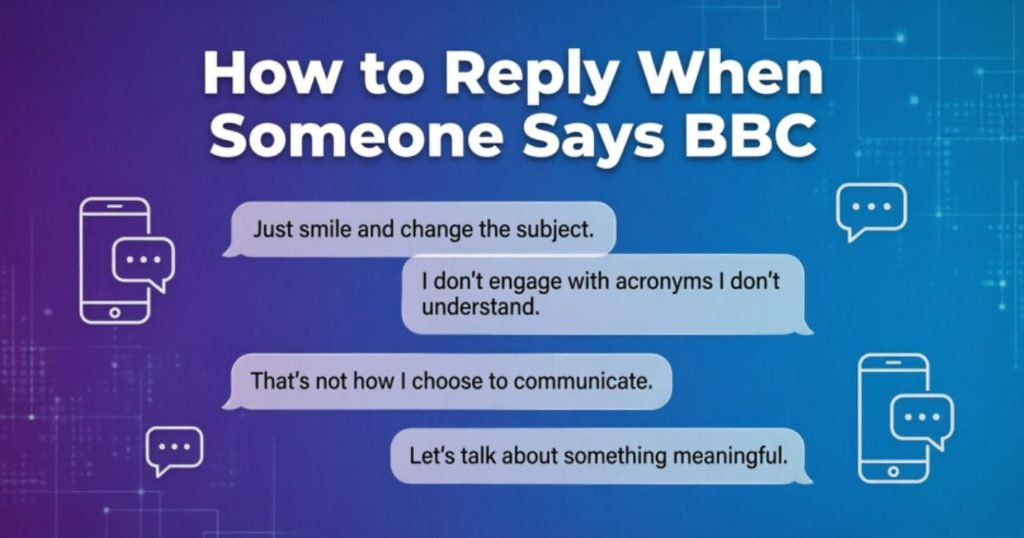
If someone sends “BBC” and the meaning isn’t obvious, the simplest and safest response is to ask directly:
- “What do you mean by BBC?”
- “Are you talking about the news channel?”
- “Not sure what you mean, can you clarify?”
If a conversation shifts into something explicit or inappropriate and you’re not comfortable with it, it’s completely reasonable to say so plainly and change the subject or end the conversation:
- “I’m not into this kind of conversation.”
- “Let’s talk about something else.”
You’re never obligated to keep engaging with a conversation that’s made you uncomfortable.
Comparison Table
| Category | British Broadcasting Corporation | Adult Slang Meaning |
| Meaning | UK national broadcaster | Racialized sexual stereotype term |
| Context | News, TV, radio, official media | Adult content, explicit chat |
| Tone | Neutral, informational | Explicit, adult-oriented |
| School suitability | Appropriate | Not appropriate |
| Workplace suitability | Appropriate | Not appropriate |
| Common usage | Everyday, widespread | Limited to adult contexts |
Who Uses the BBC?
The British Broadcasting Corporation is used and referenced by a broad, general audience journalists, students, researchers, casual viewers, and anyone following UK or international news. Its name appears constantly across mainstream media, education, and everyday conversation.
The slang interpretation, by contrast, appears mainly in adult content spaces and related online communities. It isn’t tied to a specific demographic or age group in any verifiable way, and making assumptions about who uses which meaning isn’t a reliable context in the conversation itself is the better guide.
Origin and Internet Culture Insight
The BBC broadcaster was founded in 1922 as the British Broadcasting Company, becoming the British Broadcasting Corporation in 1927 under a royal charter. It has since grown into one of the world’s most recognized public broadcasters, covering news, entertainment, and educational programming.
The slang meaning developed separately, within adult content and internet culture, likely gaining traction as adult media became widely distributed online and slang terms spread through forums, memes, and social platforms.
As social media use grew, so did general awareness that BBC could carry more than one meaning making context-checking more important than ever.
Is BBC Rude?
The BBC itself isn’t inherently rude. As the broadcaster’s name, it’s completely neutral and used constantly in respectful, everyday contexts like news and education.
The slang meaning can be considered rude, explicit, or inappropriate depending on the setting, since it’s sexual in nature and references a racial stereotype. Whether it comes across as rude largely depends on where and how it’s used. The same three letters aren’t offensive in a news headline.
Is BBC a Bad Word?
BBC is not a bad word on its own. It’s an initialism with two very different meanings, and only one of those meanings the adult slang sense is inappropriate in most everyday settings.
Context is what determines whether BBC reads as completely normal or as something explicit. Treating it as universally “bad” or universally “fine” misses that distinction.
Should You Use BBC at School or Work?
Using BBC to refer to the British Broadcasting Corporation is entirely appropriate at school or work for example, citing a BBC News article or referencing a BBC documentary in a presentation.
The slang meaning should not be used in professional or educational settings under any circumstances, since it’s explicit and can be considered offensive or a stereotype-based term. If there’s any risk of ambiguity, spelling it out “BBC News” or “the BBC broadcaster” removes the guesswork entirely.
Brief vs Debrief
These two words sometimes get confused with acronym-style terms, but they’re unrelated to BBC entirely.
- Brief a short summary or a quick set of instructions given before something happens. Example: “The manager gave the team a brief before the meeting started.”
- Debrief a discussion held after an event to review what happened. Example: “We’ll debrief after the project wraps up to see what went well.”
Both are standard English words, not abbreviations, and neither carries any slang meaning.
Experience-Based Insight
When you come across an ambiguous term like BBC online, a quick three-part check usually clears things up:
- Topic What was the conversation already about before the BBC came up? News, TV, and current events point to the broadcaster.
- Tone Is the message neutral and informational, or flirtatious and suggestive? Tone often reveals intent faster than the word itself.
- Relationship/platform Is this a public post, a professional chat, or a private conversation with someone you know well? Public and professional spaces lean formal; private adult-oriented chats lean slang.
Running through these three quickly, in order, resolves the vast majority of ambiguous cases without needing to ask.
Final Thoughts
BBC carries two very different meanings: the British Broadcasting Corporation, a globally recognized news and media organization, and an adult slang term found mostly in explicit online content. Neither meaning is automatically “correct” ; the surrounding words, platform, and tone decide which one applies in any given message.
When you’re unsure, the simplest solution is usually the best one: look at the context, and if it’s still unclear, just ask. That small step avoids misunderstandings and keeps the conversation on solid ground.

Welcome to Meaning Mints! I ‘m Olivia Justin , an Ai-powered SEO, and Content Writer with 4 years of experience.
I help website rank higher, grow traffic , and look amazing. My goal is to make SEO and web design simple and effective for everyone.
Let’s achieve more together |
