

If someone suddenly sends you “WTH,” you may wonder whether they are confused, surprised, annoyed, or simply joking. The three-letter abbreviation is short, but its tone can change significantly depending on the conversation.
In everyday texting, WTH most commonly means “What the hell?” or the softer “What the heck?” It is an informal reaction used when something seems surprising, confusing, strange, frustrating, or hard to believe. Current slang references and recent search results consistently describe these as the main texting meanings.
WTH appears in private messages, group chats, social media comments, memes, gaming conversations, and other casual online spaces. It can be playful between friends, but the same abbreviation can sound irritated when paired with an accusatory question or harsh wording.
This guide explains the WTH meaning in text, its full form, common uses, social media meaning, history, examples, alternatives, and the best ways to reply.
Quick Answer: What Does WTH Mean in Text?
WTH usually stands for “What the hell?” or “What the heck?” It is an informal texting abbreviation used to express surprise, confusion, disbelief, frustration, or mild annoyance. The exact tone depends on context.
WTH Meaning at a Glance
| Term | Full Form | Main Use | Tone | Setting |
| WTH | What the hell / What the heck | Reaction to something unexpected | Surprised, confused, amused, or annoyed | Casual texting and social media |
| WTH? | What the hell? / What the heck? | Direct reaction or question | Usually stronger because of the question mark | Chats, comments, DMs |
| WTH 😂 | What the heck/hell? | Funny disbelief | Playful or amused | Friends and social media |
| WTH! | What the hell/heck! | Strong reaction | Shock or frustration | Informal conversations |
What Does WTH Mean in Text & Chat?
WTH is a common internet and texting abbreviation for “What the hell?” or “What the heck?” People use it when they want to react quickly to something unexpected or confusing.
The phrase does not always indicate anger. Someone can use WTH after hearing surprising news, seeing something strange, watching a funny video, or discovering that something went wrong.
For example:
“WTH just happened?”
This could mean “What the heck just happened?” in a surprised or confused way.
“WTH are you doing?”
Depending on the relationship and context, this may sound curious, shocked, annoyed, or critical.
“WTH 😂”
The laughing emoji can make the reaction feel playful rather than angry.
The important point is that WTH is an emotional reaction, not simply a replacement for one exact sentence. Its meaning becomes clearer when you look at the surrounding words, punctuation, emojis, and conversation.
Full Form, Stands For & Short Meaning of WTH
The most common full forms of WTH are:
- What the hell
- What the heck
“What the hell” is the stronger interpretation, while “what the heck” is commonly used as a milder alternative. Both communicate a similar reaction to something unexpected or confusing.
In simple English, WTH can often be understood as:
- What is happening?
- What just happened?
- Why did that happen?
- Seriously?
- What is going on?
- I cannot believe this.
However, these are interpretations rather than additional official full forms. The abbreviation itself is generally connected to the two phrases above.
WTH is also sometimes written as “wth” in lowercase. Capitalization usually does not change the meaning. Lowercase WTH may simply feel more relaxed or casual.
WTH in Memes, Comments & Reaction Posts
WTH works especially well as a reaction because it is short and instantly communicates emotion. That makes it common in meme comments, reaction posts, short videos, and funny online conversations.
A person may comment “WTH 😭” under a video with an unexpected ending. Another user might write “WTH did I just watch?” after seeing something unusual.
In these situations, WTH may not be a serious question. It can be a dramatic reaction designed to make the comment more expressive.
Common meme-style uses include:
- “WTH 😂” something is unbelievable or funny.
- “WTH did I just see?” confusion or surprise.
- “WTH is going on?” disbelief about a strange situation.
- “WTH 😭” dramatic disbelief, often humorous.
Social media gives WTH a flexible tone because images, videos, emojis, punctuation, and comments all provide additional context.
How to Use WTH Without Sounding Rude
WTH is informal, so your audience matters. The abbreviation can be harmless among close friends but may sound disrespectful when directed at someone you barely know.
A simple rule is to consider whether the message is reacting to a situation or attacking a person.
“WTH happened to the website?”
This usually targets the situation.
“WTH are you doing?”
This can sound more confrontational because it directly targets another person.
If you want a softer tone, use “what the heck,” “what happened?”, “wait, what?”, or “seriously?” instead.
Avoid WTH in situations where professional or highly respectful language is expected. Formal emails, official messages, applications, school communication, and important customer-service conversations usually benefit from complete and neutral wording.
Tone is especially important because short text messages do not include facial expressions or voice tone. A phrase that sounds funny when spoken can look harsh on a screen.
Origin, History & First Known Use of WTH
WTH developed as an abbreviation of the spoken expression “what the hell,” with “what the heck” becoming a common softer interpretation. Its growth is closely connected to the broader culture of internet abbreviations and fast digital communication.
However, it is difficult to identify one universally accepted person, message, or exact date as the definitive first use of WTH in texting. Modern abbreviations often develop gradually across forums, messaging systems, online communities, and personal conversations.
The basic idea is straightforward: digital communication rewards short expressions. Instead of typing the entire phrase, users can write WTH and still communicate surprise or disbelief in three letters.
It belongs to the same broad family of reaction-based internet shorthand that includes expressions such as LOL, OMG, WTF, and BRB, although each has a different meaning and tone.
Some current online guides discuss WTH as a long-established texting abbreviation, while newer pages focus mainly on its present-day use across social platforms.
How People Use WTH in Daily Conversations
WTH can express several emotions. The most common ones are surprise, confusion, disbelief, frustration, and humorous shock.
1. Surprise
Someone tells you unexpected news.
Friend: “I just won two concert tickets.”
You: “WTH? Seriously?”
Here, WTH communicates genuine surprise.
2. Confusion
You receive a message that makes no sense.
“WTH are you talking about?”
The abbreviation signals that you do not understand the situation.
3. Disbelief
Someone tells you something difficult to believe.
“You paid that much for it? WTH?”
The speaker is questioning the situation because it seems unbelievable.
4. Frustration
Something repeatedly goes wrong.
“WTH, this app keeps crashing.”
Here, WTH communicates annoyance.
5. Humor
A friend sends a ridiculous picture.
“WTH 😂”
The emoji can turn the phrase into playful disbelief rather than genuine anger.
These examples show why WTH should not automatically be translated as anger. Context determines the emotion.
WTH Meaning Across WhatsApp, Instagram, TikTok & Snapchat
The basic meaning of WTH stays almost the same across social platforms. What changes is the way people use it and the type of content surrounding it. Recent guides consistently describe WTH appearing across WhatsApp, Instagram, TikTok, Snapchat, gaming chats, and other online conversations.
On WhatsApp, WTH commonly appears in private chats and group conversations.
Examples:
“WTH happened?”
“WTH 😂 you scared me.”
“WTH is everyone doing?”
Because WhatsApp conversations are usually personal, the relationship between the people often determines whether WTH feels playful or annoyed.
On Instagram, WTH can appear in comments, direct messages, captions, and reactions to Reels.
For example:
“WTH is this trend?”
“WTH 😂 this Reel is crazy.”
“WTH did I just watch?”
The visual content often provides the missing context. A funny Reel may make WTH playful, while a controversial post can make it sound critical.
TikTok
TikTok’s fast-moving comment culture makes short reaction slang especially useful. WTH can be used when viewers are surprised by a video’s ending, confused by a trend, or amused by something unexpected.
Examples include:
“WTH was that ending?”
“WTH 😂”
“WTH did I just watch?”
On TikTok, exaggeration is common in comments, so WTH may be intentionally dramatic rather than genuinely angry.
Snapchat
Snapchat conversations are usually quick and informal, so WTH fits naturally into short replies.
Someone may send a surprising picture and receive “WTH?” in response. The sender may then explain what happened.
Because Snapchat messages can be brief, surrounding context becomes especially important.
Different Meanings of WTH in Other Fields
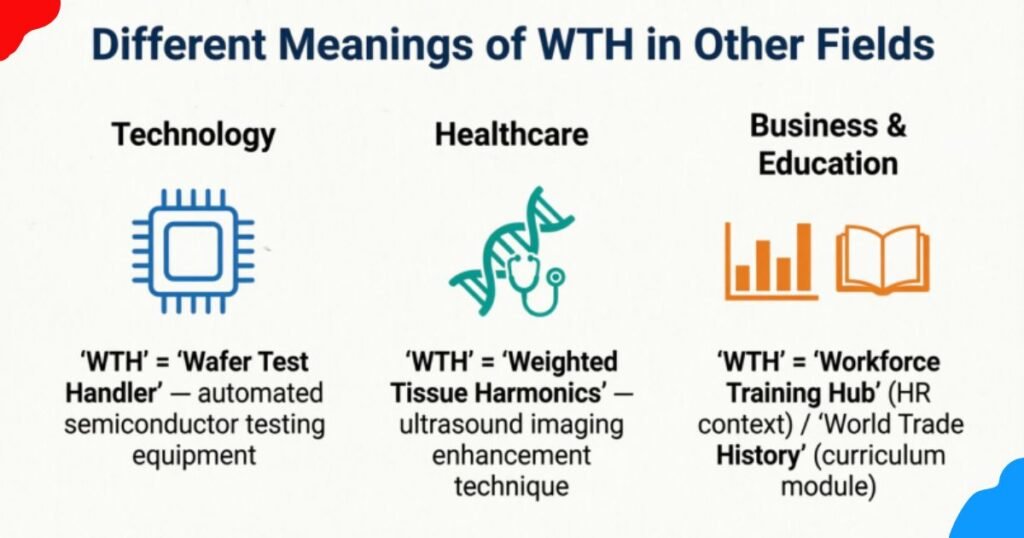
In casual texting, WTH overwhelmingly refers to “what the hell” or “what the heck.” In professional or technical fields, however, abbreviations can have completely different meanings.
This is why you should not automatically assume every occurrence of WTH has a slang definition. An acronym can represent a technical phrase, organization, project, measurement, or internal term in a specialized context.
For everyday internet language, the slang meaning is the relevant one. For academic, workplace, scientific, or technical material, always check the field-specific context before expanding an abbreviation.
The same three letters can mean different things in different industries, so a dictionary of texting slang is not a substitute for a field-specific glossary.
Common Confusions, Mistakes & Wrong Interpretations
Mistake 1: Assuming WTH always means anger. It does not. WTH can show surprise, confusion, amusement, or disbelief.
Mistake 2: Treating WTH and WTF as identical. Both can express strong surprise, but WTF is generally considered more explicit and stronger. WTH is often used as a milder alternative.
Mistake 3: Ignoring punctuation. “WTH?” can sound like a direct question. “WTH 😂” is more likely to be playful. “WTH!!!” can communicate stronger emotions.
Mistake 4: Ignoring emojis. An emoji can completely change the perceived tone. A laughing emoji can soften a reaction, while an angry emoji can make it sound more serious.
Mistake 5: Using WTH with everyone. Slang depends on familiarity. A friend may understand it immediately, while a teacher, employer, client, or unfamiliar contact may not appreciate the informal tone.
Mistake 6: Assuming lowercase and uppercase have different definitions. “WTH,” “wth,” and “Wth” generally carry the same basic meaning. Capitalization mainly affects style and emphasis.
Similar Terms, Alternatives & Related Slang
WTH is part of a larger group of short reaction expressions. Knowing the differences helps you choose the right tone.
| Term | Common Meaning | Typical Tone | Strength |
| WTH | What the hell / What the heck | Surprise, confusion, disbelief | Mild to moderate |
| WTF | What the f*** | Strong surprise or frustration | Stronger |
| OMG | Oh my God | Surprise or excitement | Mild |
| LOL | Laughing out loud | Humor | Mild |
| BRB | Be right back | Informational | Neutral |
| IDK | I don’t know | Uncertainty | Neutral |
| Seriously? | Expresses disbelief | Surprised or annoyed | Mild |
| What happened? | Requests an explanation | Neutral | Very mild |
| Wait, what? | Shows confusion or surprise | Casual | Mild |
If you want a safer alternative to WTH, “Wait, what?” is often an excellent choice because it communicates surprise without the stronger slang element.
Also Read This: GYG Meaning in Text
Examples of WTH in Real Chat Situations
The meaning becomes easier to understand when WTH is placed into realistic conversations.
Example 1: Unexpected news
A: “I got tickets for tomorrow.” B: “WTH? How?”
Meaning: B is surprised and wants to know how it happened.
Example 2: Confusing message
A: “We’re meeting at the usual place, but not the usual time.” B: “WTH does that mean?”
Meaning: B is confused.
Example 3: Funny video
A: “Look at this video 😂” B: “WTH 😂”
Meaning: B finds the video ridiculous or unexpectedly funny.
Example 4: Technical problem
A: “The website deleted my draft.” B: “WTH? Did you save it?”
Meaning: B is shocked and concerned.
Example 5: Mild frustration
A: “The meeting was moved again.” B: “WTH, seriously?”
Meaning: B is frustrated by the repeated change.
Example 6: Direct confrontation
A: “I changed the plan without telling you.” B: “WTH are you doing?”
Meaning: The phrase may sound angry or confrontational because it directly challenges the other person.
The same abbreviation can therefore move from humorous to serious depending on the sentence around it.
How to Reply When Someone Says WTH
There is no single correct reply. Your response should match what the sender appears to mean.
If they are surprised, explain the surprising information.
Example: “Yeah, I know! I wasn’t expecting it either.”
If they are confused, give a short clarification.
Example: “I mean we’re meeting at 7 instead of 6.”
If they are joking, you can reply casually.
Example: “😂 I know, right?”
If they sound annoyed, avoid immediately becoming defensive. Explain what happened.
Example: “Sorry, I should have told you earlier.”
If you cannot understand their intention, ask a simple question:
“What happened?”
or
“Are you surprised or annoyed?”
In most everyday conversations, a calm explanation is better than matching an angry tone.
Is WTH Still Popular? Trends & Online Usage
Yes, WTH remains recognizable in casual online communication in 2026. Recent search results and current slang guides continue to describe it as an active abbreviation used in texts, comments, social media, gaming chats, and private conversations.
However, online slang is constantly changing. Younger users may switch between abbreviations, short phrases, emojis, reaction images, and newer internet expressions depending on the platform and community.
That does not make WTH obsolete. It simply means the abbreviation exists alongside many newer ways of expressing surprise or disbelief.
Its continued usefulness comes from simplicity. Three letters can communicate an immediate emotional reaction without requiring a full sentence.
At the same time, WTH is less suitable for formal communication. The more professional the setting, the more useful it is to replace slang with clear wording.
Brief vs Debrief: Understanding WTH in Seconds
A brief gives you the essential answer quickly. A debrief looks at the surrounding details and explains why the answer changes with context.
Brief: WTH usually means “What the hell?” or “What the heck?” It expresses surprise, confusion, disbelief, frustration, or humorous shock.
Debrief: To understand the exact tone, check:
- What was said before WTH?
- Is the sender reacting to a person or a situation?
- Are there emojis?
- Is the punctuation strong?
- Is the conversation serious or playful?
- Are you talking privately or in a formal setting?
For example, “WTH 😂” after a funny video is probably playful. “WTH are you doing?” in a tense conversation may sound annoying.
The abbreviation stays the same. The context changes the message.
When Should You Use WTH?
WTH works best in informal communication where the people involved already understand casual internet slang.
Good situations include:
- Texting close friends
- Casual group chats
- Social media comments
- Meme reactions
- Gaming conversations
- Informal online communities
- Casual messages with people who know your texting style
Avoid it when:
- Writing a formal email
- Sending a professional application
- Communicating with an unfamiliar professional contact
- Writing an official notice
- Discussing a sensitive matter where tone needs to be precise
- You are unsure whether the recipient understands slang
If there is any doubt, use a clearer phrase such as “What happened?”, “Wait, what?”, or “What is going on?”
WTH vs What the Heck vs What the Hell
These expressions communicate a similar basic reaction, but their tone is not identical.
| Expression | Typical Tone | Best Use |
| WTH | Informal and flexible | Casual chats and social media |
| What the heck? | Softer | General casual conversation |
| What the hell? | Stronger | Informal conversations with people you know |
| What happened? | Neutral | Almost any ordinary conversation |
| Wait, what? | Casual and mild | Surprise or confusion |
If you want to express surprise without sounding harsh, “Wait, what?” is usually safer than WTH.
Conclusion
The WTH meaning in text is usually simple: “What the hell?” or “What the heck?” But understanding the abbreviation is only the first step. The real meaning depends on the situation, relationship, punctuation, emojis, and platform.
WTH can show surprise when a friend shares unexpected news, confusion when a message makes no sense, frustration when something goes wrong, or humor when someone reacts to a ridiculous video. Current slang references and recent search results consistently identify these emotional uses as the core of WTH in online communication.

Welcome to Meaning Mints! I ‘m Olivia Justin , an Ai-powered SEO, and Content Writer with 4 years of experience.
I help website rank higher, grow traffic , and look amazing. My goal is to make SEO and web design simple and effective for everyone.
Let’s achieve more together |
