

If someone sends you “CYA” in a message, the meaning is usually simple, but not always. In casual texting, CYA most commonly means “See Ya” or “See You,” a short and informal way to say goodbye.
In workplace or business conversations, however, CYA can mean “Cover Your Ass,” which refers to protecting yourself from blame, confusion, or future problems by keeping records and documenting decisions.
The correct meaning depends entirely on context. This guide explains the CYA meaning in text, chat, business, email, medical settings, and social media, with practical examples and easy ways to respond. Major dictionaries such as Collins recognize both the messaging meaning and the business meaning, so neither one is a fringe interpretation.
What Does CYA Mean in Text?
CYA usually means “See Ya” or “See You” in text messages. It is a casual farewell used when someone is ending a conversation, leaving, going offline, or signaling that they expect to see the other person again. For example, “I have to go now, CYA!” simply means “I have to go now, see you!”
The expression is informal and feels most natural in conversations with friends, classmates, family members, or online contacts you know well. CYA is essentially a shortened written form of the spoken phrase “see ya.” You say “see ya” out loud, and when you type it, the three letters C-Y-A capture the same sound with less effort.
The abbreviation follows the sound of the spoken phrase, much like “CU” for “see you.”
CYA Meaning in Text and Chat
In text and chat, CYA almost always works as a quick goodbye when the surrounding conversation is casual. It can appear at the beginning or end of a short message, but it is most commonly placed at the end, as the last thing someone says before leaving.
Here are some typical examples:
- “I’m heading home now, CYA!”
- “Okay, I have class. CYA later.”
- “Nice talking to you, cya tomorrow.”
- “I need to log off. CYA!”
Capitalization does not normally change the meaning. “CYA,” “cya,” and “Cya” can all mean the same thing. What matters far more than capitalization is the surrounding conversation.
CYA Meaning in Business

CYA has a completely different meaning in business and workplace communication. Here, it can stand for “Cover Your Ass.” It refers to taking reasonable steps to protect yourself from blame, disputes, misunderstandings, or responsibility later.
A person might use “CYA” when recommending that someone keep emails, approvals, documents, notes, or other records that show what happened and who agreed to what. In this context, CYA is workplace slang rather than a friendly farewell.
Dictionaries describe this usage as referring to policies and practices designed to protect a person from criticism or liability.
Examples of the business meaning include:
- “Keep the approval email for CYA.”
- “I saved the signed document just to CYA.”
- “Send the update by email so there is a record, CYA.”
There is an important caution here. Because the phrase behind this meaning contains profanity, it is informal and should generally be avoided in formal client-facing communication.
Even among colleagues, it is wise to read the room before using it, since some workplaces are more relaxed about language than others.
CYA Full Form and Slang Usage
CYA has two major meanings in modern communication. In everyday texting, CYA means “See Ya” or “See You.” In business slang, it means “Cover Your Ass.” These meanings are unrelated, which is exactly why context is essential.
| CYA meaning | Common context | Tone | Example |
| See Ya / See You | Texting, chat, social media | Casual and friendly | “CYA tomorrow!” |
| Cover Your Ass | Business, workplace, documentation | Informal and sometimes blunt | “Save the email for CYA.” |
The two meanings share three letters by coincidence, not because one grew out of the other.
Definition & Meaning: A Deeper Explanation
The easiest way to understand CYA is to look at the situation around it. If someone says “CYA later” after discussing plans with a friend, it means “see you later.” If a coworker says “Keep that message for CYA,” the subject has changed from saying goodbye to protecting oneself through documentation.
The same three letters therefore carry different meanings depending on the topic, the relationship between the people talking, and the communication setting. Here is a quick guide to how situations usually map to meanings:
| Situation | Likely meaning | Interpretation |
| Friend ending a chat | See ya | Goodbye or see you later |
| Gaming conversation | See ya | See you next time |
| Workplace discussion | Cover Your Ass | Protect yourself with documentation |
| Medical record | Context-dependent | Do not assume the texting meaning |
CYA Meaning in Email
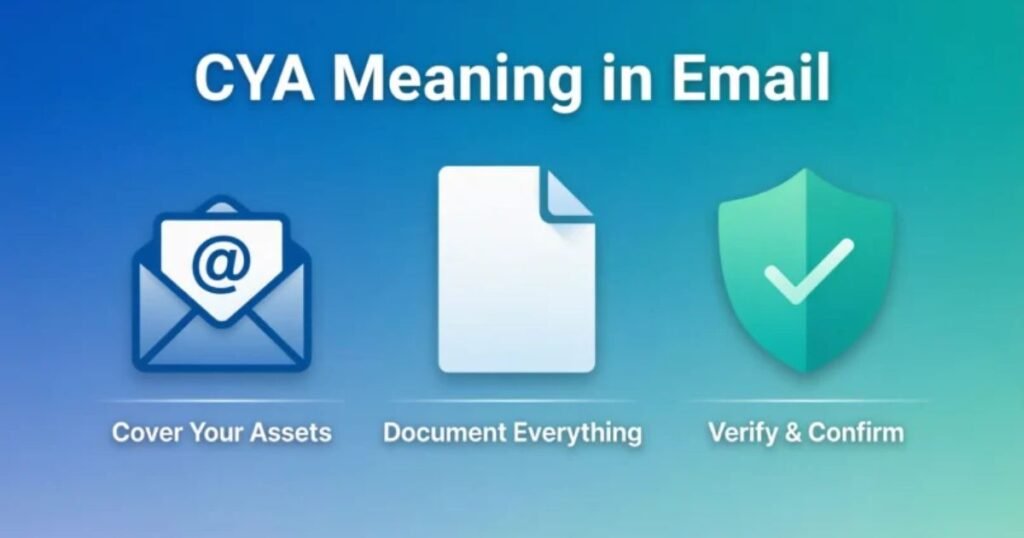
In an informal email between friends, CYA can mean “see you,” especially when the sender is signing off before meeting again. However, in professional email, CYA may refer to “Cover Your Ass,” particularly when people discuss documentation, responsibility, approvals, or potential disputes.
Email can be forwarded and read by clients or managers, so avoid ambiguous slang in formal writing.
Examples across different tones:
- Casual: “CYA at the game tonight!”
- Professional context: “I saved the approval email for CYA.”
- Formal alternative: “I have retained the approval email for documentation.”
Why People Use CYA (Psychology Explained)
People use CYA because short expressions reduce typing effort and make casual communication feel relaxed. In texting, abbreviations also signal familiarity. Someone who writes “CYA” may expect the other person to understand informal online language, and using it can create a feeling of closeness.
It says, in effect, “we are comfortable enough with each other to skip the formalities.”
In workplace slang, the motivation is different. “CYA” communicates caution in a compact way. It can signal that someone wants a record of a decision or wants to reduce the chance of being blamed later.
In both cases the abbreviation saves time, but the social purpose changes with the context: one builds warmth, the other builds protection.
How to Use CYA in Text (Practical Guide)
Use CYA when the conversation is informal and you want a short, friendly goodbye. It works best when the other person already understands casual texting language. Follow these steps:
- Use CYA near the end of a casual conversation.
- Add a time or event when you want to make the meaning clearer.
- Use lowercase or uppercase according to your normal texting style.
- Avoid it when the message needs a formal or professional tone.
- If the conversation is serious, consider using a clearer phrase such as “talk later” or “take care.”
Some examples you can borrow:
- “Gotta go, CYA!”
- “CYA tomorrow at school.”
- “Okay bro, cya later.”
- “Thanks for chatting. CYA!”
CYA Meaning in Medical Contexts

CYA does not have one universal medical meaning. In medical and scientific contexts, abbreviations can be field-specific and sometimes overlap with common slang. One established use is CyA or CYA for cyclosporine A, also called ciclosporin, an immunosuppressive medicine.
Also Read This: NMMS Meaning in Text
Medical references list CYA among the abbreviations associated with cyclosporine, and dermatology resources use the term CyA when discussing the drug.
Because medical abbreviations can vary between institutions, CYA in a clinical document should not automatically be interpreted as “see ya” or “cover your ass.”
The surrounding medical text and the source document determine the intended meaning. A line in a prescription or treatment note is a very different setting from a text message to a friend.
If an abbreviation affects medication instructions or treatment, it should be confirmed with a qualified healthcare professional rather than guessed.
This is one of the clearest examples of why ambiguous abbreviations carry real risk: a wrong guess in a casual chat costs nothing, but a wrong guess about a medication could matter a great deal.
Usage in Different Contexts
JP can have different meanings depending on the conversation and platform. In casual texting, it may represent a slang phrase, initials, or a person’s name. In online discussions, JP can sometimes refer to Japan.
Its intended meaning is best understood by checking the surrounding words, topic, and relationship between the people communicating.
summarizes how CYA is typically understood in different settings:
| Context | Meaning | Tone |
| Casual texting | See ya / See you | Friendly |
| Group chat | See ya | Casual |
| Gaming | See you later | Relaxed |
| Business | Cover Your Ass | Informal workplace slang |
| Formal email | Usually avoid | Too informal or ambiguous |
| Medical writing | Context-dependent, including CyA/CYA | Technical |
Is CYA Rude in Text?
Usually, no. When CYA means “see ya,” it is normally friendly and casual. However, a one-word message can sometimes feel cold depending on the conversation.
For example, “CYA!” after making plans sounds relaxed and upbeat, while a sudden “cya.” after an emotional discussion may feel dismissive.
The period at the end, the lack of any warm words, and the timing can all change how it lands. The word itself is not automatically rude; tone, punctuation, relationship, and context influence how it is received.
CYA Meaning on Snapchat, TikTok & Instagram
CYA generally does not have a special definition on Snapchat, TikTok, or Instagram. On these platforms, it normally keeps its casual “see ya” meaning when used in messages, comments, or conversations. Slang guides consistently describe the same basic meaning across the major social platforms.
| Platform | Common meaning | Typical use |
| Snapchat | See ya / see you | Ending a quick chat or snap conversation |
| TikTok | See ya / see you | Comments, messages, or casual conversations |
| See ya / see you | DMs and casual chats |
CYA Meaning in Chat vs Messages
There is little difference between CYA in a chat and CYA in a text message. In both situations, it usually means “see ya” or “see you.” The important difference is not the platform but the context.
A casual conversation about plans points toward the farewell meaning, while a workplace discussion about records or responsibility can point toward “cover your ass.”
Professional Communication
CYA should be used carefully in professional communication. If you mean “see you,” choose a clearer phrase such as “See you tomorrow,” “Talk to you later,” or “See you at the meeting.”
If you mean the workplace concept of protecting yourself, use professional wording such as “for documentation,” “to maintain a record,” or “for accountability.” This removes ambiguity and avoids the profanity associated with the informal expression.
Brief vs. Debrief: A Related Workplace Idea
Documentation habits often connect to two other workplace terms: brief and debrief.
- A brief gives a short summary of important information, often before or during a task.
- A debrief reviews what happened after an event, task, or situation.
In workplace communication, CYA may involve keeping a record that supports what happened. A brief prepares people with information, while a debrief looks back at the outcome.
Hidden or Risky Meanings
CYA is not usually a hidden or risky slang term in ordinary texting. The main risk is misunderstanding its meaning. A friend may use CYA as a simple goodbye, while a coworker may use the same letters as workplace slang.
Medical documents create another possibility, because CYA or CyA can refer to cyclosporine A.
The safest approach is to identify the subject of the conversation before interpreting the abbreviation.
Comparison with Similar Terms
CYA is similar to phrases like “see you,” “see ya,” “talk later,” and “goodbye,” but it is shorter and more casual. Unlike standard farewells, CYA can also have other meanings depending on context.
Understanding the conversation helps determine whether CYA is simply a goodbye, a warning, or a reference to another phrase.
CYA is one of many short goodbyes. Here is how it compares:
| Term | Meaning | Tone |
| CYA | See ya / see you | Casual |
| Bye | Goodbye | Neutral |
| Later | See you later | Casual |
| TTYL | Talk to you later | Casual |
| CU | See you | Very informal |
| BRB | Be right back | Casual, but not a final goodbye |
10 Slang Terms Related to CYA
If you want to expand your vocabulary of casual farewells, these ten expressions are closely related:
- Bye: a standard way to end a conversation.
- Later: a casual short form suggesting you will talk or meet again.
- TTYL: “talk to you later.”
- CU: “see you,” another short texting form.
- C U: a phonetic version of “see you.”
- Take care: a friendly farewell that sounds slightly warmer.
- Catch you later: an informal way to say you will see someone again.
- See ya: the phrase represented by CYA.
- Talk soon: a casual promise or expectation of another conversation.
- BRB: “be right back,” usually meaning the person is temporarily leaving rather than ending the conversation.
How to Respond to CYA
How you respond to CYA depends on the context and the person using it. If CYA means “see ya,” a simple “See you!” or “Talk later!” works well. In a professional conversation, respond politely with something like “Thanks, speak soon” or “Have a great day.
If CYA is being used to mean “cover your actions,” clarify the intended meaning before replying. Since CYA can have different interpretations, consider the conversation, tone, and relationship before choosing your response. This helps prevent confusion, especially in workplace or unfamiliar conversations.
If someone sends CYA meaning “see ya,” the easiest response is another casual farewell. You do not need a complicated answer. Good replies include:
- “CYA!”
- “See you!”
- “Later!”
- “See ya tomorrow!”
- “Take care!”
- “Talk soon!”
If CYA is being used in a workplace context, respond to the actual issue rather than treating it as a goodbye. For example, if someone says “Save the email for CYA,” you can respond with “Got it, I’ll keep the record.” That shows you understood the purpose without repeating the slang.
When NOT to Use CYA
Avoid CYA when clarity and professionalism are more important than speed. This is especially true in formal communication. Skip it in:
- Formal business emails
- Client-facing messages
- Academic writing
- Official documents
- Serious complaints or sensitive conversations
- Medical communication where an abbreviation could be misunderstood
- Messages to people who may not understand texting slang
In these situations, write the full phrase or use a clearer professional expression.
Common Mistakes to Avoid
- Assuming CYA always means “see ya.” Context can change the meaning.
- Using CYA in a formal email without considering how informal it sounds. What feels quick to you may look careless to a client.
- Assuming capitalization creates a different definition. Uppercase and lowercase versions carry the same meaning.
- Reading “cya” as rude without considering the surrounding conversation. Brevity is not hostility.
- Interpreting a medical abbreviation without checking its clinical context. Always confirm when health information is involved.
- Confusing CYA with BRB. BRB normally means the person plans to return shortly.
- Using the workplace meaning with people who may not know the slang. Not everyone will understand it, and some may be offended by the wording.
Conclusion
The CYA meaning in text is usually simple: “See Ya” or “See You.” It is a casual farewell used in texts, chats, social media conversations, and other informal digital communication. However, CYA has another important meaning in business: “Cover Your Ass,” an informal expression about protecting yourself from future blame or disputes through documentation. Medical contexts can introduce additional meanings, including CyA for cyclosporine A.
The best way to understand CYA is to check the context, topic, and tone before interpreting it. For casual conversations, CYA is usually harmless and friendly. For formal, professional, or medical communication, clearer wording is often the better choice.

Welcome to Meaning Mints! I ‘m Olivia Justin , an Ai-powered SEO, and Content Writer with 4 years of experience.
I help website rank higher, grow traffic , and look amazing. My goal is to make SEO and web design simple and effective for everyone.
Let’s achieve more together |
