

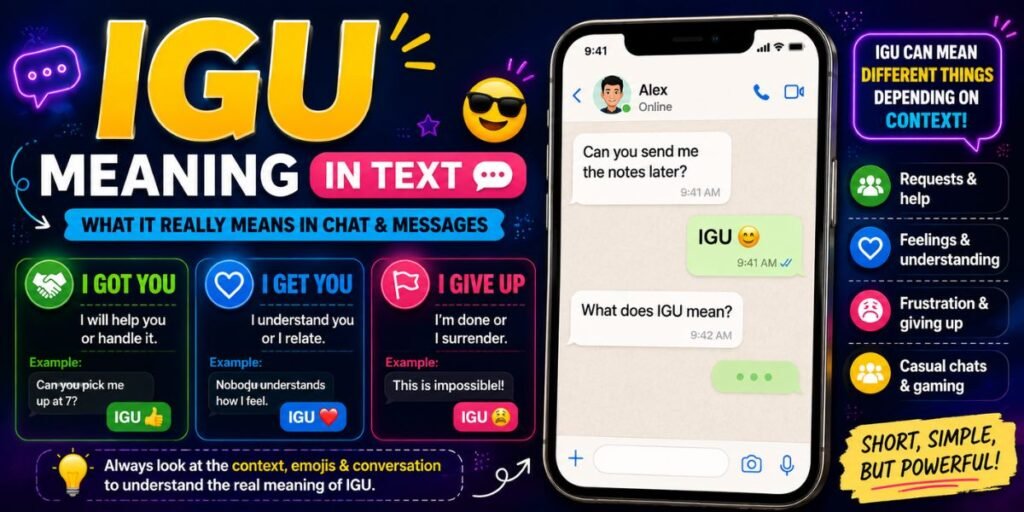
If someone sends you “IGU” in a text, DM, comment, or group chat, the meaning is not always obvious. Unlike common abbreviations such as LOL or BRB, IGU can represent more than one phrase, so the surrounding conversation matters. In modern texting, IGU can mean “I Got You,” “I Get You,” or “I Give Up,” depending on context. This guide explains the IGU meaning in text, its use on different platforms, tone and context variations, real chat examples, grammar, appropriate replies, internet culture, safety, and frequently asked questions.
IGU Meaning: Quick Answer
IGU is an informal texting abbreviation that can commonly mean “I Got You,” “I Get You,” or “I Give Up.” The correct meaning depends on the conversation and the situation.
| IGU Meaning | What It Communicates | Typical Context |
| I Got You | I will help or handle it | Requests, plans, and support |
| I Get You | I understand or relate to you | Emotional or casual conversations |
| I Give Up | I am done or surrendering | Frustration, arguments, games, or difficult tasks |
Meaning & Explanation
IGU = I Got You
One common use of IGU is “I Got You.” In this sense, the abbreviation communicates support, agreement, reassurance, or willingness to help. It can mean “Sure, I can do that,” “Don’t worry, I’ll handle it,” “I understand,” or “You can count on me.”
Example: Friend: “Can you send me the notes tonight?” You: “IGU.” Meaning: I got you.
IGU = I Get You
IGU can also mean “I Get You,” particularly when the conversation is about feelings, opinions, or personal experiences. In this situation, it communicates understanding or empathy.
Example: Person A: “Everyone keeps telling me to relax, but they don’t understand how stressful this is.” Person B: “IGU.” Meaning: I get you.
IGU = I Give Up
Another established texting meaning is “I Give Up.” This interpretation is normally used when someone is frustrated, tired of trying, unable to solve a problem, or joking about defeat.
Example: Person A: “Did you solve that impossible puzzle?” Person B: “IGU 😭” Meaning: I give up.
IGU Meaning on Different Platforms
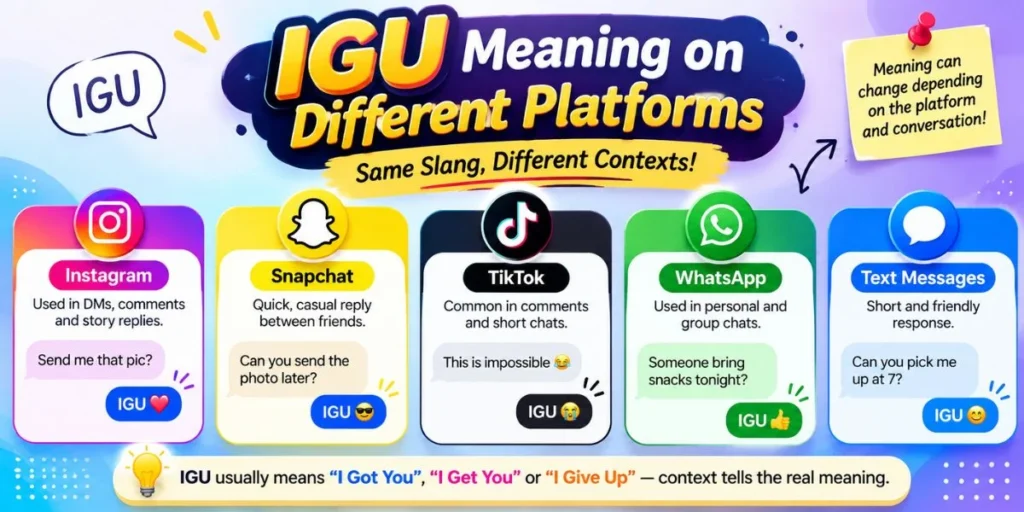
IGU on Text Messages
In ordinary texting, IGU may be used as a quick response to a request, statement, or problem. For example, if someone asks, “Can you pick me up at 7?” and receives “IGU,” it most likely means “I got you.”
IGU on Instagram
Instagram DMs, comments, and story replies often use short expressions because conversations are fast and informal. IGU may communicate acknowledgment, support, understanding, or humorous frustration.
IGU on Snapchat
Snapchat conversations commonly favor short and informal replies. If someone asks, “Can you send me the picture later?” and receives “IGU,” which most likely means “I got you.”
IGU on TikTok
TikTok comments frequently use abbreviations as humorous, exaggerated, or relatable reactions. IGU may communicate empathy, understanding, or playful defeat depending on the video and comment thread.
IGU on WhatsApp and Group Chats
In WhatsApp conversations and group chats, IGU can work as a quick confirmation. For example: “Someone bring the snacks.” “IGU.” Here, the meaning is most likely “I got you.”
Tone & Context Variations
Context is the most important factor when interpreting IGU. The same three letters can communicate support in one conversation and frustration in another.
- “Need me to cover your shift? IGU.” → I got you.
- “Are you going to keep arguing about this? IGU.” → I give up.
What shapes the meaning:
- The previous message
- The topic of the conversation
- Emojis
- Punctuation
- The relationship between the people
- The overall tone
Real Chat Examples
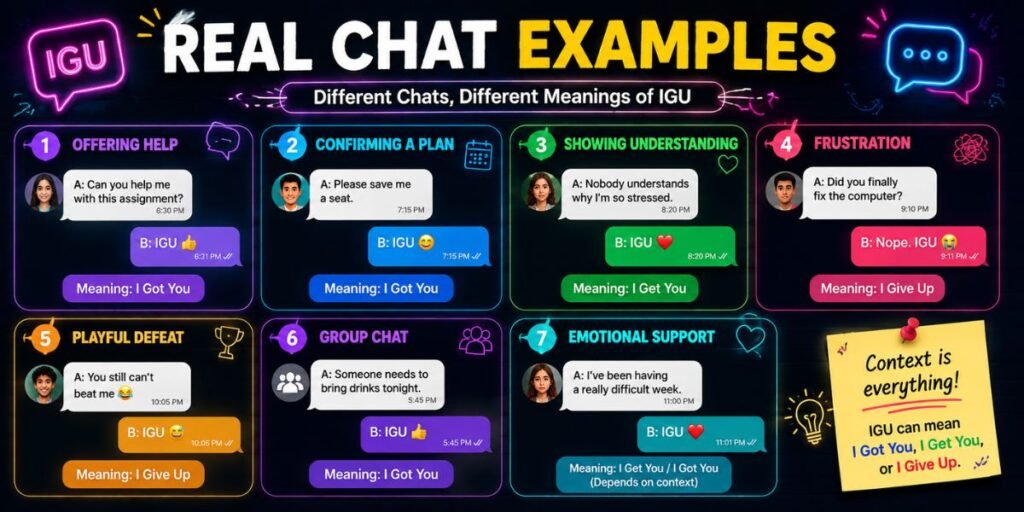
| Situation | Chat | Meaning |
| Offering Help | A: “Can you help me with this assignment?” B: “IGU.” | I got you. |
| Confirming a Plan | A: “Please save me a seat.” B: “IGU 👍” | I got you. |
| Showing Understanding | A: “Nobody understands why I’m stressed.” B: “IGU.” | I get you. |
| Frustration | A: “Have you finally fixed the computer?” B: “Nope. IGU 😭” | I give up. |
| Playful Defeat | A: “You still can’t beat me at this game 😂” B: “IGU.” | I give up. |
| Group Chat | A: “Someone needs to bring drinks tonight.” B: “IGU.” | I got you. |
| Emotional Support | A: “I’ve been having a really difficult week.” B: “IGU ❤️” | I get you or I got you, depending on context. |
Grammar & Language Role
IGU is not standard formal English. It is an informal abbreviation used for quick digital communication. In formal English, you would normally write the complete phrase: “I got you,” “I get you,” or “I give up.”
It sits alongside other common texting abbreviations such as IDK, BTW, BRB, IMO, LOL, TBH, and LMK.
Also Read This: EVB Meaning in Text
Note: IGU can appear as IGU, igu, or Igu. Capitalization usually does not change the intended meaning.
Brief vs Debrief
A brief provides essential information quickly, while a debrief is a discussion that reviews what happened after an event or situation. IGU can function as a brief response because three letters can communicate a larger idea.
For example, “Can you take care of it?” followed by “IGU” provides a short reassurance. If clarification is needed, a longer debrief can explain whether IGU meant “I got you,” “I get you,” or “I give up.”
How to Reply When Someone Says IGU
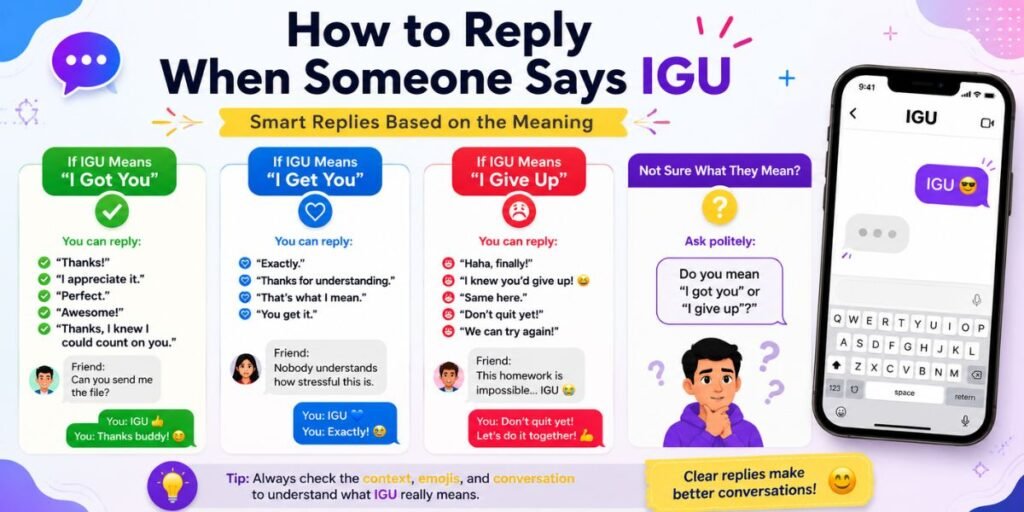
If IGU means “I Got You”:
- Thanks!
- I appreciate it.
- Perfect.
- Thanks, I knew I could count on you.
- Awesome.
If IGU means “I Get You”:
- Exactly.
- Thanks for understanding.
- That’s what I mean.
- You get it.
If IGU means “I Give Up”:
- Haha, finally!
- I knew you’d give up 😂
- Same.
- Don’t quit yet!
- We can try again.
If you are unsure: simply ask, “Do you mean I got you or I give up?” Asking for clarification is the safest option because IGU is context-dependent.
Comparison Table
“I Got You” is the supportive version of IGU it means the person will help or handle something, and it typically shows up in response to requests or plans. “I Get You” carries an empathetic tone, signaling that the person understands or relates to what’s being said, and it usually appears in conversations about feelings or opinions. “I Give Up” is the frustrated or playful version, used when someone is surrendering after a problem, an argument, or a losing game. IGU itself is just the informal shorthand for whichever of these three phrases fits the context it shows up across texts and online chats, and its tone shifts depending on which meaning applies.
| Phrase | Meaning | Tone | Common Situation |
| I Got You | I will help or handle it | Supportive | Requests and plans |
| I Get You | I understand you | Empathetic | Feelings and opinions |
| I Give Up | I am surrendering | Frustrated or playful | Problems, arguments, or games |
| IGU | Short form of one of the above | Informal | Texts and online chats |
Who Uses This Term?
IGU is mainly suited to casual digital communication. It may appear among friends, teenagers, young adults, online communities, gamers, social media users, and group-chat participants. There is no strict age requirement, and anyone familiar with the abbreviation may use it.
There is no universal gender-specific meaning for IGU. Whether the sender is a man or woman does not determine the definition the conversation does.
Origin & Internet Culture
IGU belongs to the broader culture of internet slang and texting abbreviations.
Online communication encourages people to shorten phrases because messages are often fast, informal, and conversational. This has contributed to the popularity of abbreviations such as LOL, IDK, BRB, and BTW.
The exact origin of every use of IGU is difficult to establish because internet slang develops across different communities and platforms.
This is also why different slang websites may list different meanings for IGU.
One source may emphasize “I Give Up,” while another may focus on “I Got You.”
The important point is that internet slang is flexible, and meaning can vary between communitie
Safety & Appropriateness
IGU is generally harmless slang, but it is informal. It is suitable for friendly texts, casual DMs, group chats, social media comments, gaming conversations, and informal online communities. It is better to avoid IGU in job applications, academic assignments, formal emails, business reports, and official documents.
Formal alternatives:
- “I understand.”
- “I’ll take care of it.”
- “I understand what you mean.”
- “I agree.”
- “I am unable to continue.”
Because IGU has multiple interpretations, using it without context can cause confusion. In formal communication, spelling out the complete phrase is clearer.
Real-World Observation
IGU is a good example of why context matters in internet slang.
Consider:Can you help me tomorrow?
IGU.
The response sounds supportive.
Now consider:I’ve tried everything and nothing works.
IGU 😭
The same abbreviation sounds like frustration or surrender.
The letters are identical, but the conversation changes the meaning.
This happens because digital communication does not always include voice tone, facial expressions, or body language. Users therefore rely on the surrounding words, emojis, punctuation, and situation to communicate their intended tone.
Conclusion
IGU meaning in text depends heavily on context. The abbreviation can commonly represent “I Got You,” “I Get You,” or “I Give Up.” When IGU follows a request, it often communicates support or willingness to help. When it follows an emotional statement, it can express understanding or empathy.
The best way to interpret IGU is to look at the complete conversation, tone, emojis, and situation rather than relying on the abbreviation alone. For casual texting and social media, IGU can be a convenient shortcut. For professional or formal communication, spelling out the complete phrase is clearer and less likely to cause confusion.
IGU = I Got You / I Get You / I Give Up context tells you which one.

Welcome to Meaning Mints! I ‘m Olivia Justin , an Ai-powered SEO, and Content Writer with 4 years of experience.
I help website rank higher, grow traffic , and look amazing. My goal is to make SEO and web design simple and effective for everyone.
Let’s achieve more together |
