

Two letters, two very different worlds. If you’ve seen “JS” tacked onto the end of a text message, there’s a good chance it has nothing to do with coding and if you’ve seen it in a developer’s chat, it almost certainly has nothing to do with opinions or gossip.
This little abbreviation is one of the clearer examples of how the same shorthand can carry completely different meanings depending on where you encounter it.This guide breaks down what JS means in everyday texting, when it switches to a technical meaning, how to tell the difference at a glance, and how people actually use it in real conversations.
The Short Definition
In casual texting, JS almost always means “Just Saying.” It’s a small conversational tag people attach to an opinion, observation, or piece of advice to make it feel less like a firm statement and more like a passing thought. It typically shows up at the end of a sentence, softening whatever came before it.
Example: “That was kind of a weird thing to say, js.”
Here, JS signals that the sender is simply offering their take rather than issuing a verdict. It’s the texting equivalent of shrugging after you say something a little blunt.
Outside of casual chat, though, JS has an entirely different and very well-established meaning: JavaScript, the programming language that powers interactivity on countless websites and web applications. In a coding conversation, “just saying” would make no sense at all, and readers naturally default to the technical meaning instead.
| Context | Likely meaning |
| Text message, DM, social comment | Just Saying |
| Programming or tech conversation | JavaScript |
| Specialized or organizational context | Varies check the source |
When People Use JS in a Text
JS shows up most often right after someone has said something that could otherwise land a little too directly. It’s a way of taking the edge off a comment while still saying what you actually think.
Common situations where it appears:
- Sharing an opinion “That episode wasn’t as good as the last one, js.”
- Giving light advice “You might want to double check that before sending it, js.”
- Making an observation “You’ve been on your phone the entire time, js.”
- Adding a joke or teasing comment “You really thought that plan would work, js 😂.”
- Softening criticism “The food was fine, just a little cold, js.”
In each case, the sentence would still make sense without JS attached. What the abbreviation adds is framing a small signal that says “this is just my take, take it or leave it.” It doesn’t erase the point being made; it just changes how directly it lands.
Because of that framing effect, JS fits comfortably into casual texting, group chats, and social media comments, but it’s not something you’d typically reach for in a formal email, a school assignment, or any situation where you want your statement to sound authoritative rather than casual.
Telling the Difference: Just Saying vs. JavaScript
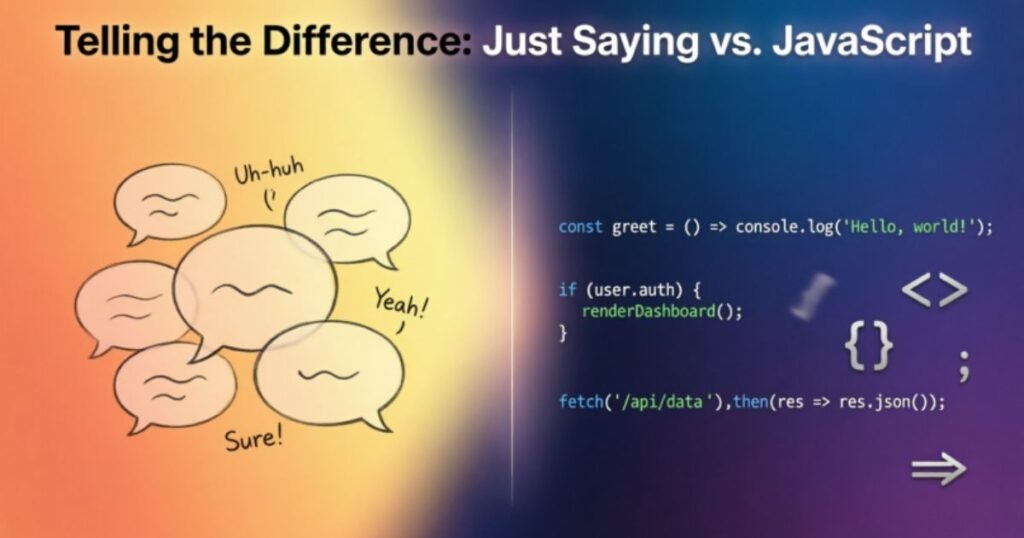
Since the two meanings are so far apart, context does almost all the work of clarifying which one is intended. A few reliable signals:
It probably means “Just Saying” when:
- It appears at the very end of a sentence, almost like a tag.
- The sentence before it is an opinion, complaint, or piece of advice.
- The conversation topic is everyday life, friends, plans, entertainment, relationships, and school drama.
- Swapping in the words “just saying” makes the sentence read naturally.
Example: “You were the one who picked the restaurant, js.”
It probably means JavaScript when:
- The message includes words like code, website, developer, browser, function, framework, HTML, CSS, or Node.
- The sender is discussing a project, bug, class assignment, or piece of software.
- Swapping in “just saying” makes the sentence nonsensical.
Example: “The JS on this page keeps throwing an error.”
In that second example, nobody would read “just saying” into it; the surrounding vocabulary makes the technical meaning obvious immediately.
Does JS Have an Official Full Form?
In casual texting, the accepted full form is simply “Just Saying.” It isn’t a formal or dictionary-recognized abbreviation, but it’s widely and consistently used this way across messaging apps, comment sections, and social platforms enough that most people recognize it instantly in an informal context.
In technology, the full form is JavaScript, and this usage is far more official and long-standing, going back to the language’s creation and its widespread adoption in web development. Developers, students learning to code, and anyone working with websites will almost always default to this meaning.
A less common variation you might come across is JS being used as an abbreviated form of the word “just” on its own, without the “saying” implied though this is far less standard and depends heavily on the individual sender’s texting habits.
JS in School Conversations

Context matters just as much in a school setting as anywhere else. Between classmates chatting casually, JS is very likely to mean “just saying” for example, “That test was way harder than the teacher said it would be, js.”
But if the conversation shifts to a computer science or web development class, JS almost certainly refers to JavaScript instead. A student might text, “Don’t forget the JS homework is due tomorrow,” and mean the programming assignment specifically.
The word “school” doesn’t lock in one particular meaning: the subject being discussed within that school conversation is what actually determines it.
Where This Abbreviation Came From
Like most internet shorthand, JS developed organically out of the broader culture of instant messaging, SMS, and online chat, where shorter messages were faster to type and helped conversations feel quick and casual. “Just sayin'” as a spoken phrase predates texting by a long stretch, and its abbreviation followed naturally once digital communication demanded brevity.
Documented use of “js” for “just sayin'” appears in early internet slang references and message-board culture, though as with most crowd-sourced slang it’s difficult to pin an exact origin point or single inventor on it. It’s better understood as shorthand that spread gradually through repeated use across forums, texts, and chat rooms rather than something coined deliberately by one person or platform.
How People Use JS Day to Day
In practice, JS functions like a small conversational stamp placed after the main point of a message. A few typical patterns:
Opinion: “Honestly, that song is overrated, js.”
Observation: “You’ve said that same thing three times today, js.”
Advice: “You should probably text them back before tonight, js.”
Light criticism: “Your outfit choice today is… interesting, js.”
Humor or teasing: “You definitely didn’t finish that assignment on time, js 😂.”
Worth noting: attaching JS to a sentence doesn’t automatically make it gentle or inoffensive. “You should have handled that better, js” still communicates criticism that the abbreviation changes the framing, not necessarily the impact. How a message lands still depends heavily on tone, relationship, and what’s actually being said.
JS in Programming and Tech Conversations

Among developers, students, and anyone working on websites or apps, JS is essentially shorthand people reach for constantly, much the way “HTML” or “CSS” gets used without anyone spelling out the full term.
Typical examples:
- “I’m learning JS this semester.”
- “Can you check the JS file for errors?”
- “This feature is built with vanilla JS, no frameworks.”
- “The JS console is showing a warning.”
In every one of these, “just saying” clearly doesn’t apply the sentence structure and surrounding vocabulary make the JavaScript meaning unmistakable. This is one of the more useful things to remember about the abbreviation: technical settings almost never leave room for ambiguity.
Also Read This: What Does Hyy Mean in Text
JS Across Different Messaging Platforms
The core meaning of JS stays fairly consistent across apps; the format and audience shift more than the definition itself.
| Platform | Typical use |
| Casual opinions between friends or family, e.g. “That was a bit much, js.” | |
| Comments and DMs adding a casual take, e.g. “Kind of a bold choice, js.” | |
| TikTok | Quick reactions in comments, e.g. “This trend needs to end, js.” |
| Snapchat | Short, casual asides in chats, e.g. “You’re always late, js.” |
Across all of these, the sentence surrounding JS still does the heavy lifting in determining tone and intent; the platform itself doesn’t add a hidden layer of meaning.
Other Meanings of JS Outside Texting and Coding
Beyond the two dominant meanings, JS can pop up as shorthand in other, narrower contexts for instance, as an abbreviation within certain military, organizational, or institutional settings, or simply as someone’s initials in a personal message.
None of these are widely recognized outside their specific setting, so if you come across “JS” in a professional document, report, or specialized field, it’s worth checking that particular source’s terminology rather than assuming either the “just saying” or JavaScript meaning applies automatically.
Common Mistakes People Make With JS
A handful of misunderstandings come up repeatedly:
Assuming it always means “just saying.” This breaks down quickly in any coding or tech-related conversation.
Assuming JS automatically makes a comment gentle. As mentioned earlier, the underlying statement still carries its original tone JS just adds a casual wrapper around it.
Confusing it with romantic subtext. JS isn’t inherently flirty or meaningful beyond its literal function; it’s simply a way of framing an opinion.
Ignoring the sentence it’s attached to. The two letters alone tell you very little the words immediately before them are what actually carry the meaning.
Treating every instance as identical. A playful “js 😂” after a joke reads very differently from a flat “js” after criticism, even though the abbreviation itself hasn’t changed.
Similar Abbreviations Worth Knowing
JS sits alongside a small family of similar conversational tags, each with a slightly different flavor:
| Term | Meaning | Typical tone |
| JS | Just Saying | Casual, low-stakes opinion |
| IJS | I’m Just Saying | Slightly more emphatic version of JS |
| IMO | In My Opinion | Personal viewpoint |
| IMHO | In My Humble Opinion | Softer, more deferential opinion |
| TBH | To Be Honest | Direct or candid comment |
| NGL | Not Gonna Lie | Honest reaction, often admitting something |
| FYI | For Your Information | Neutral, informational |
JS tends to be one of the lighter options on this list, useful when you want to add a thought without it sounding like a formal declaration or a strong emotional statement.
Real Chat Examples
Casual opinion: A: “Did you like the show?” B: “It dragged a bit toward the end, js.”
Giving advice: A: “I’ll just leave whenever.” B: “You might want to plan ahead a little, js.”
Playful teasing: A: “Why does everyone keep interrupting me?” B: “You do talk a lot, js 😂.”
Technical context: A: “What are you working on this week?” B: “Cleaning up some JS bugs on the site.”
Social comment: A: “This is definitely the best version.” B: “I actually liked the original more, js.”
How to Respond When Someone Texts You JS
There’s rarely a need to overanalyze it. If the comment before JS was a harmless opinion, a casual acknowledgment works fine:
- “Fair point.”
- “Haha, okay, noted.”
- “I see what you mean.”
- “That’s fair, I guess.”
- “Lol, okay.”
If the statement felt more pointed or you’re not sure what they meant, it’s perfectly reasonable to ask directly rather than guess. And if JS shows up in a technical conversation, just respond to the programming context, no interpretation needed there at all.
Is JS Still Common Today?
Yes. As a piece of everyday texting shorthand, JS remains widely used and easily recognized, particularly among people who grew up texting and chatting online regularly. Its brevity is exactly what keeps it in circulation; it does a small but useful job (softening or framing a statement) in just two characters.
On the technical side, its use is arguably even more entrenched, since JavaScript itself isn’t going anywhere and “JS” is the standard shorthand developers reach for constantly, whether in code comments, documentation, or casual shop talk.
Why Context Clues Matter More Than the Letters Themselves
It’s worth pausing on why two letters can carry such different weight depending on where they show up. Abbreviations like JS survive in language because they’re efficient; they let people skip typing out a full phrase while still getting the meaning across.
But that efficiency only works because both people in the conversation share enough context to fill in the blank correctly. A friend texting about a TV show and a developer debugging a website are both relying on the same two letters, but they’re drawing on completely different mental libraries of vocabulary to decode them.
This is actually a pattern you’ll notice across a lot of internet slang, not just JS. Short forms tend to multiply meanings over time because they get reused across different communities. Texting culture, gaming culture, workplace culture, and tech culture all borrow and repurpose shorthand independently of each other.
What JS Says About Modern Texting Habits
Looking at JS as part of a bigger picture, it reflects something fairly universal about short-form digital messages: a constant effort to add nuance without adding length. A lot of texting culture has evolved around small tags and stylistic tweaks that hedge a statement or soften an opinion in just a couple of characters.
JS fits that pattern alongside “lol,” “ngl,” or “tbh.” None of these words change what’s being said, they change how it’s received. Attaching “js” to an opinion doesn’t make it less true; it signals the sender isn’t trying to start an argument.
The abbreviation itself is part of the tone using JS instead of spelling it out tells the reader “this is a relaxed message” before they’ve even finished reading the sentence.
A Closer Look at Tone and Delivery
Because JS is so often used to frame an opinion, the tone of the message immediately before it matters enormously. The exact same two letters can come across as playful, neutral, or a little sharp depending entirely on what precedes them.
Consider these three variations:
- “You looked great today, js.” Reads as a genuine compliment with a light, casual finish.
- “That was kind of awkward, js.” Reads as a mild observation, not necessarily critical.
- “You really should’ve thought that through, js.” Reads noticeably more pointed, even with the softening tag attached.
The lesson here is that JS isn’t a magic word that automatically makes every statement land gently. It’s more like a stylistic seasoning; it can take the edge off a comment, but it can’t fully cancel out a genuinely critical or blunt statement. Readers of a message should weigh the sentence as a whole rather than assuming the presence of “js” guarantees a friendly or harmless tone.
JS in Group Chats and Public Comments
In a group chat or public comment section, JS often takes on a slightly more performative role than in one-on-one messages, a way of saying “this is just my take, not an attack on anyone specific” before others weigh in.
It’s especially common under posts and videos attached to a critique or unpopular opinion, like “Honestly this recipe looks overrated, js.” In these public settings, the abbreviation acts almost like a pre-emptive shrug, letting someone share a critical opinion without inviting an argument.
Regional and generational habits shift things too. Younger texters often stack JS with related tags in one message (“kind of mid, ngl, js”), while others rarely use it at all and prefer spelling things out. None of that changes the core meaning it just reflects how unevenly slang spreads across groups and platforms.
Final Takeaway
The meaning of JS almost entirely depends on where you find it. In an everyday text, it’s shorthand for “Just Saying” a small conversational cushion people add after an opinion, observation, or bit of advice. In a coding or tech conversation, it refers to JavaScript, with no ambiguity at all once you notice the surrounding vocabulary.
Rather than trying to memorize a single fixed definition, the more reliable approach is to read the whole message. If someone just shared an opinion and tacked “js” onto the end, they’re telling you it’s just their take. If someone’s debugging a website, they’re talking about code. Context does nearly all of the interpretive work; the two letters themselves are just the starting point.

Welcome to Meaning Mints! I ‘m Olivia Justin , an Ai-powered SEO, and Content Writer with 4 years of experience.
I help website rank higher, grow traffic , and look amazing. My goal is to make SEO and web design simple and effective for everyone.
Let’s achieve more together |
