

If you’ve spotted the letters “SPWM” in a text message, a DM, a comment section, or a group chat, you’ve probably paused to figure out what it means. Unlike well-worn abbreviations like LOL, BRB, or IDK, SPWM isn’t universally recognized, and its meaning shifts depending on where you encounter it. In casual texting, the most widely reported interpretation is “Stop Playing With Me.” People use it when they think someone is joking around, exaggerating, teasing them, or telling them something that’s hard to believe.
At the same time, SPWM carries a completely different and very established meaning in electronics and power engineering, where it stands for Sinusoidal Pulse Width Modulation, a switching technique used in inverters and power-conversion equipment. In that world, the term describes a method where a sine-wave reference signal gets compared against a faster carrier wave to generate a pattern of switching pulses.
What Does SPWM Mean in Text and Chat?
In everyday texting, SPWM typically means “Stop Playing With Me.” It’s a shorthand way of calling someone out for joking, teasing, stretching the truth, or dropping a piece of news that seems too wild to be real.
Sometimes it’s a genuine request to knock it off; other times it’s closer to an expression of disbelief or excitement dressed up as mild annoyance.
Here’s a simple example:
“I just bought tickets for the concert.”
“SPWM 😭”
In this exchange, SPWM isn’t really an accusation, it reads more like “Wait, are you actually serious?” The tone can swing from playful shock to genuine surprise depending on everything else happening in the conversation.
Slang references generally agree that SPWM doesn’t carry one fixed emotional weight. It flexes based on the relationship between the people texting, the subject being discussed, and whatever punctuation or emoji is attached.
That’s why it’s more useful to think of SPWM as a reaction abbreviation, a quick, low-effort way to signal a feeling rather than a term with a single locked-in definition.
Why Context Changes Everything
The exact same four letters can land as a joke in one thread and as a pointed comment in another. A few quick examples make the difference clear:
- “SPWM 😂” reads as playful disbelief, nothing serious.
- “SPWM 😭” could be shock, excitement, or straightforward disbelief.
- “SPWM bro.” carries a slightly more serious or irritated tone.
- “SPWM, are you serious?” a direct request for honesty.
- “SPWM ❤️” fits comfortably in a flirty or affectionate exchange.
Who sends the message matters just as much as what it says. A close friend firing off “SPWM” is almost certainly joking. The same word from someone mid-argument reads very differently, closer to a warning than a laugh.
The subject matter is another giveaway. If the conversation is about weekend plans, relationships, gossip, or a wild claim someone just made, the slang meaning almost certainly applies.
But if you’re reading a technical paper, a circuit design forum, or an inverter spec sheet, SPWM is referring to Sinusoidal Pulse Width Modulation, full stop the slang meaning simply doesn’t belong in that setting.
Is PWM the Same Thing as SPWM?
Not quite. On its own, PWM stands for Pulse Width Modulation, a broader engineering term describing any method of controlling power or signal strength by adjusting how long a pulse stays “on” versus “off.” It shows up constantly in electronics from LED dimming to motor speed control.
In casual chat, plain “PWM” isn’t a recognized abbreviation the way SPWM is; if you see it used conversationally, it’s likely a personal shorthand specific to that person or group rather than an established slang term.
The extra “S” at the front of SPWM is what pulls it into technical territory, since it’s the standard shorthand for the sinusoidal variant of PWM used throughout power electronics. In slang, though, that same “S” is simply part of the phrase “Stop Playing With Me” ; it doesn’t carry any special weight on its own.
SPWM in Electronics and Power Engineering
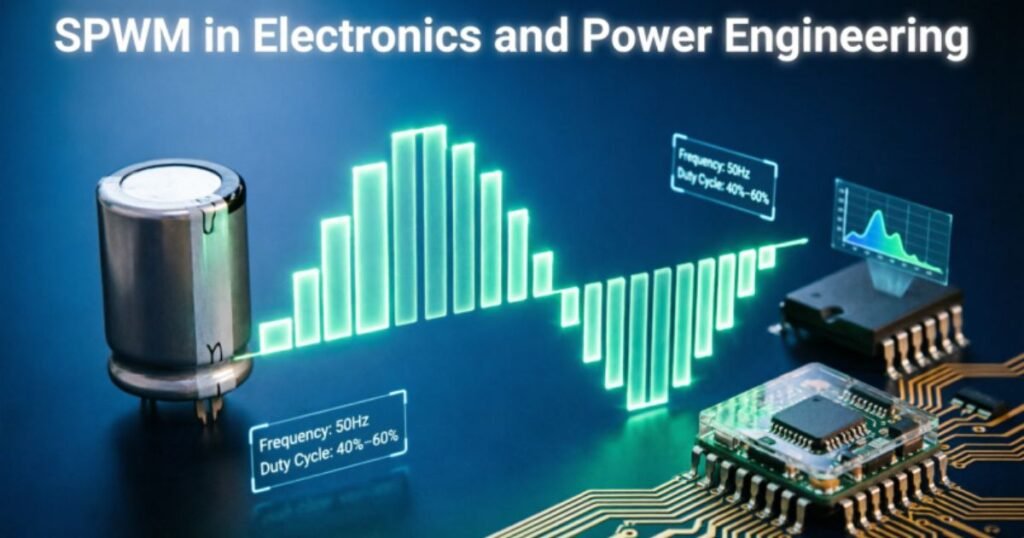
Switching over to the technical side, SPWM stands for Sinusoidal Pulse Width Modulation, a modulation technique that’s a staple of power electronics, particularly in inverters and converters that change DC power into AC power.
The underlying idea is fairly approachable even without an engineering background. A smooth, sine-shaped reference signal is compared against a much faster carrier wave usually triangular in shape.
Wherever the sine wave sits above the triangle wave, a switch turns on; wherever it sits below, the switch turns off. Repeating this comparison rapidly produces a stream of pulses whose widths trace out the shape of the original sine wave, even though each individual pulse is just an on/off signal.
Once generated, this pulse pattern drives the switching components inside an inverter, letting the device produce an output waveform that behaves like the desired AC signal once it’s filtered and smoothed.
SPWM shows up constantly in simulation software and control systems for anything involving AC power conversion or electric motor drives. Circuit-simulation platforms commonly include built-in SPWM models for three-phase converters, and various motor-control tutorials use SPWM inverter setups as a teaching example.
Why Engineers Rely on SPWM
SPWM gives engineers a controlled, predictable way to produce an AC output with a specific fundamental frequency and amplitude, all without needing extra circuitry to shape the waveform after the fact.
By tweaking a handful of parameters the reference frequency, the carrier frequency, and the modulation index (essentially how “deep” the sine wave swings relative to the carrier) engineers can dial in exactly how the system behaves.
You’ll typically run into SPWM in:
- Power inverters (turning DC into usable AC)
- Motor drive systems
- DC-to-AC conversion equipment
- General power converters
- Electrical control and automation systems
- Simulation and modeling environments
- Class-D audio amplifier power stages
None of this has anything to do with the texting phrase “Stop Playing With Me.” The overlap is purely coincidental: two completely different communities landed on the same four-letter combination.
The Full Form of SPWM, Depending on Where You See It
Since SPWM’s meaning hinges entirely on context, it helps to see the possibilities side by side.
| Context | Full Form | What It Means |
| Texting / chat | Stop Playing With Me | A reaction to teasing, joking, or unbelievable news |
| Electronics | Sinusoidal Pulse Width Modulation | A PWM technique built around a sine-wave reference |
| Inverter systems | Sinusoidal Pulse Width Modulation | A switching method used to shape power-conversion output |
For everyday texting, the short version is simple: SPWM = Stop Playing With Me. In an engineering document, the correct expansion is always Sinusoidal Pulse Width Modulation.
What SPWM Means in an Inverter Discussion
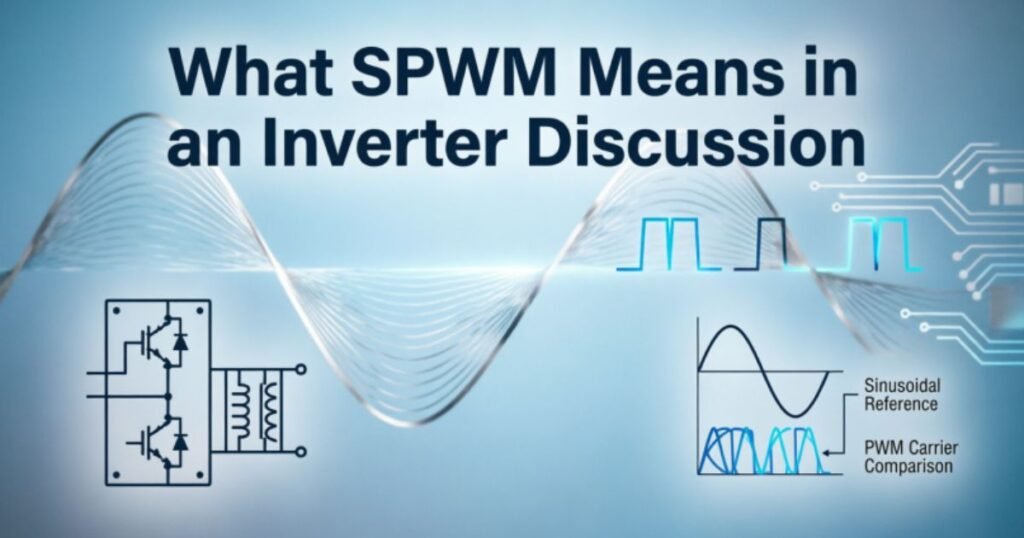
If you’re reading about inverters and come across “SPWM,” it’s referring to the engineering definition, not the slang one. An SPWM-based inverter generates its switching pulses by comparing a sine-wave reference against a carrier signal, which lets it control the shape of its output waveform with a fair amount of precision.
A typical demonstration setup might include a DC power source feeding into an inverter bridge, a sinusoidal PWM controller generating the switching signals, and an output filter that smooths the resulting pulses into something closer to a clean AC sine wave.
If you spot phrases like “SPWM inverter,” “modulation index,” “carrier frequency,” or “PWM waveform” nearby, that’s a strong signal you’re in engineering territory rather than a group chat.
Where the Slang Term Came From
The texting version of SPWM traces back to the ordinary phrase “stop playing with me,” compressed down for speed the way so much internet slang gets shortened.
There’s no single documented moment where this abbreviation was first coined like most organically-grown slang, it likely emerged gradually across group chats and social platforms rather than starting from one identifiable post or person. Claims of a precise origin date should be taken with a grain of salt.
The technical term, on the other hand, has a much clearer engineering lineage. Sinusoidal pulse-width modulation has been a foundational technique in power electronics for controlling switching devices and approximating AC waveforms for decades, and it remains a standard part of coursework, simulation tools, and real-world inverter design today.
It’s a good reminder that acronyms don’t always reveal their meaning just by spelling out the letters; sometimes the same combination develops in two totally separate directions.
How People Actually Use SPWM Day to Day
In practice, SPWM functions as a quick emotional shorthand. Instead of typing out “stop playing with me” in full, someone fires off four letters and lets the surrounding conversation fill in the rest.
Common situations where it pops up include:
- Someone tells a story that sounds too wild to be true.
- A friend cracks an obvious joke.
- Someone clearly exaggerates a situation.
- A person keeps teasing repeatedly.
- Surprising or unexpected news gets shared.
- A flirty conversation takes a playful turn.
- Someone makes a claim that sounds a little suspicious.
For example:
Friend: “I won the giveaway!”
Reply: “SPWM 😭”
Here, the reply likely translates to “No way, are you being serious right now?” rather than genuine irritation.
What Does SPWM Mean From a Girl?

If a girl sends “SPWM,” there’s no special hidden meaning tied specifically to her gender; the interpretation still comes down to the conversation itself. In most casual exchanges, it still boils down to “Stop Playing With Me.”
For example:
“I think you’re actually really funny.”
“SPWM 😭”
That reads as a playful, slightly bashful response to a compliment.
Or consider:
“I’m actually coming to your city tomorrow.”
“SPWM, seriously?”
Here it’s expressing genuine surprise or disbelief rather than annoyance.
The smarter approach is always to read the actual message, tone, and emojis rather than assuming the sender’s gender changes what the abbreviation means. Relationship context and word choice tell you far more than who typed it.
Also Read This: What Does BB Mean in Text
SPWM Across Different Platforms
Short reaction slang like SPWM fits naturally into the fast-paced nature of modern messaging, and it shows up across nearly every major platform, though the vibe can shift slightly depending on where you’re reading it.
| Platform | Typical Setting | Likely Tone |
| Private chats, group threads | Friendly, surprised, occasionally annoyed | |
| DMs and comment sections | Surprised, humorous, teasing | |
| TikTok | Video comments and replies | Disbelief, humor, shock |
| Snapchat | Quick messages, stories | Casual, playful, surprised |
| Discord | Group chats, gaming servers | Teasing, disbelief, mild frustration |
On TikTok and Instagram, a stray “SPWM” comment usually reacts to something surprising in a video or post. On WhatsApp and Snapchat, it tends to surface inside an ongoing personal back-and-forth rather than as a one-off public comment.
Across all of these platforms, the underlying rule stays the same: tone depends heavily on context, not the platform itself.
SPWM in Other Fields and Niche Communities
Beyond slang and electrical engineering, acronyms sometimes pick up specialized meanings within particular industries or online communities. SPWM is no exception, though these niche uses are far less standardized than the two main definitions covered here.
The most important distinction remains the split between slang SPWM (“Stop Playing With Me”) and technical SPWM (Sinusoidal Pulse Width Modulation). If you stumble across an unfamiliar use of the term in some other specific community, the safest move is to look at the surrounding vocabulary and subject matter rather than assuming either of the two common definitions automatically applies.
Common Mistakes People Make With SPWM
One of the most frequent errors is assuming every instance of “SPWM” refers to the slang phrase. That assumption falls apart quickly in any technical writing, where it almost always means Sinusoidal Pulse Width Modulation instead.
Another common misstep is treating SPWM as inherently rude or hostile. In reality, it’s often lighthearted especially when paired with laughing or crying-laughing emojis. It can, however, sound sharper or more confrontational when it shows up in the middle of a genuine disagreement.
People also sometimes mix SPWM up with other short abbreviations that look or sound similar, including:
- SFW Safe For Work
- SMH Shaking My Head
- STFU Shut the F*** Up
- WYM What You Mean / What Do You Mean
- FR For Real
- NGL Not Gonna Lie
These all mean something different, and none of them should be swapped in for SPWM without paying attention to the actual message.
The safest rule of thumb: read the whole message and the conversation around it before deciding what SPWM is doing there.
Similar Slang and Related Phrases
A handful of other expressions cover similar emotional ground to SPWM in everyday texting:
| Term | Meaning | Typical Use |
| SPWM | Stop Playing With Me | Calling out joking or expressing disbelief |
| FR? | For real? | Checking if something is genuinely true |
| WYM? | What do you mean? | Asking for clarification |
| Are you serious? | Direct question | Expressing disbelief |
| No way! | Surprise reaction | Responding to unexpected news |
| Stop playing | Close variant | Telling someone to quit joking |
| Be for real | Informal push | Asking someone to drop the act |
These aren’t perfect substitutes for one another, but they all serve a similar conversational purpose reacting to something that feels exaggerated, surprising, or hard to believe.
Quick Summary: Brief and Debrief
Brief: In texting, SPWM usually means “Stop Playing With Me,” used when someone is joking, teasing, exaggerating, or sharing something hard to swallow.
Debrief: The real meaning becomes obvious once you factor in the conversation, the sender, the tone, and the platform. If words like “inverter,” “carrier,” “modulation,” or “waveform” show up nearby, you’re almost certainly looking at the engineering term Sinusoidal Pulse Width Modulation instead of the slang phrase.
Real Chat Examples
1. Surprising News
Alex: “I got front-row tickets!” Sam: “SPWM 😭” Meaning: “Are you serious? No way!”
2. A Friend Is Joking
Alex: “I’m selling my phone and buying a flip phone.” Sam: “SPWM 😂” Meaning: “Stop joking around.”
3. Playful Back-and-Forth
Alex: “You know you missed me.” Sam: “SPWM lol.” Meaning: A teasing way of brushing off the claim.
4. A Suspicious Claim
Alex: “I finished the entire project in ten minutes.” Sam: “SPWM.” Meaning: “I don’t believe you.”
5. Excited Reaction
Alex: “Guess who’s coming to the party?” Sam: “SPWM WHAT?” Meaning: Genuine surprise and excitement.
6. A More Serious Exchange
Alex: “I never said that.” Sam: “SPWM. You definitely did.” Meaning: Here, the phrase leans confrontational rather than playful.
These examples highlight how much punctuation, capitalization, and emoji choice shape the actual tone behind the same four letters.
How to Respond If Someone Sends You SPWM
Match your reply to the situation. If it’s clearly a joke, keep it light. If the other person genuinely seems confused or doubtful, clear things up.
A few useful responses:
- “I’m serious 😂”
- “I swear, it’s true.”
- “Why would I joke about that?”
- “Okay okay, I’m not playing.”
- “You’ll see soon.”
- “Haha, believe me!”
If you’re not totally sure why someone dropped “SPWM” on you, a simple “What? I’m serious 😭” keeps things moving naturally without overthinking it. And you don’t need to start using the abbreviation yourself just because someone else did slang works best when it actually fits how you normally talk.
Is SPWM Still in Use?
Yes, SPWM remains a recognizable piece of informal online vocabulary heading into 2026, particularly in social media comments, DMs, and group chats where quick reaction-based slang thrives. It hasn’t reached the near-universal status of terms like LOL or IDK, but it’s stuck around as a shorthand for playful disbelief.
Its staying power fits a broader trend in digital communication: people regularly compress familiar phrases into short abbreviations once the meaning can be inferred from context. That said, usage varies by platform, community, region, and age group, so it’s worth not assuming everyone you talk to will recognize it the same way.
Worth noting for anyone researching the term: search results for “SPWM” often blend texting slang with electronics content, precisely because the acronym carries legitimate meaning in both spaces.
Final Takeaway
The most common SPWM meaning in text is “Stop Playing With Me,” a quick reaction people send when something sounds like a joke, an exaggeration, or news too surprising to be true right away. Depending on the conversation, it can express disbelief, excitement, playful frustration, skepticism, or genuine annoyance.
Context decides everything. A “SPWM 😭” dropped in a group chat is almost certainly slang, while “SPWM inverter” in a technical discussion is talking about Sinusoidal Pulse Width Modulation, a well-established method for generating switching pulses in power-conversion systems.

Welcome to Meaning Mints! I ‘m Olivia Justin , an Ai-powered SEO, and Content Writer with 4 years of experience.
I help website rank higher, grow traffic , and look amazing. My goal is to make SEO and web design simple and effective for everyone.
Let’s achieve more together |
